
God, Politics & Party
A Two-Part Series for Those Who Struggle With Where Politics Ends and Faith Begins
“Every generation faces its own battle for truth, and ours is no different. The danger today is not persecution from without, but deception from within. The most effective lies are not shouted in rebellion but whispered in the language of love, progress, and compassion. They sound noble, they feel kind, and they appear moral — yet they slowly replace obedience with emotion, and truth with tolerance.” — C. J. Bartels
Matter of Fact Books is making both books available to read free of charge for a limited time, in the hope that, if you identify as a Christian, you will truly understand what you have chosen to believe.
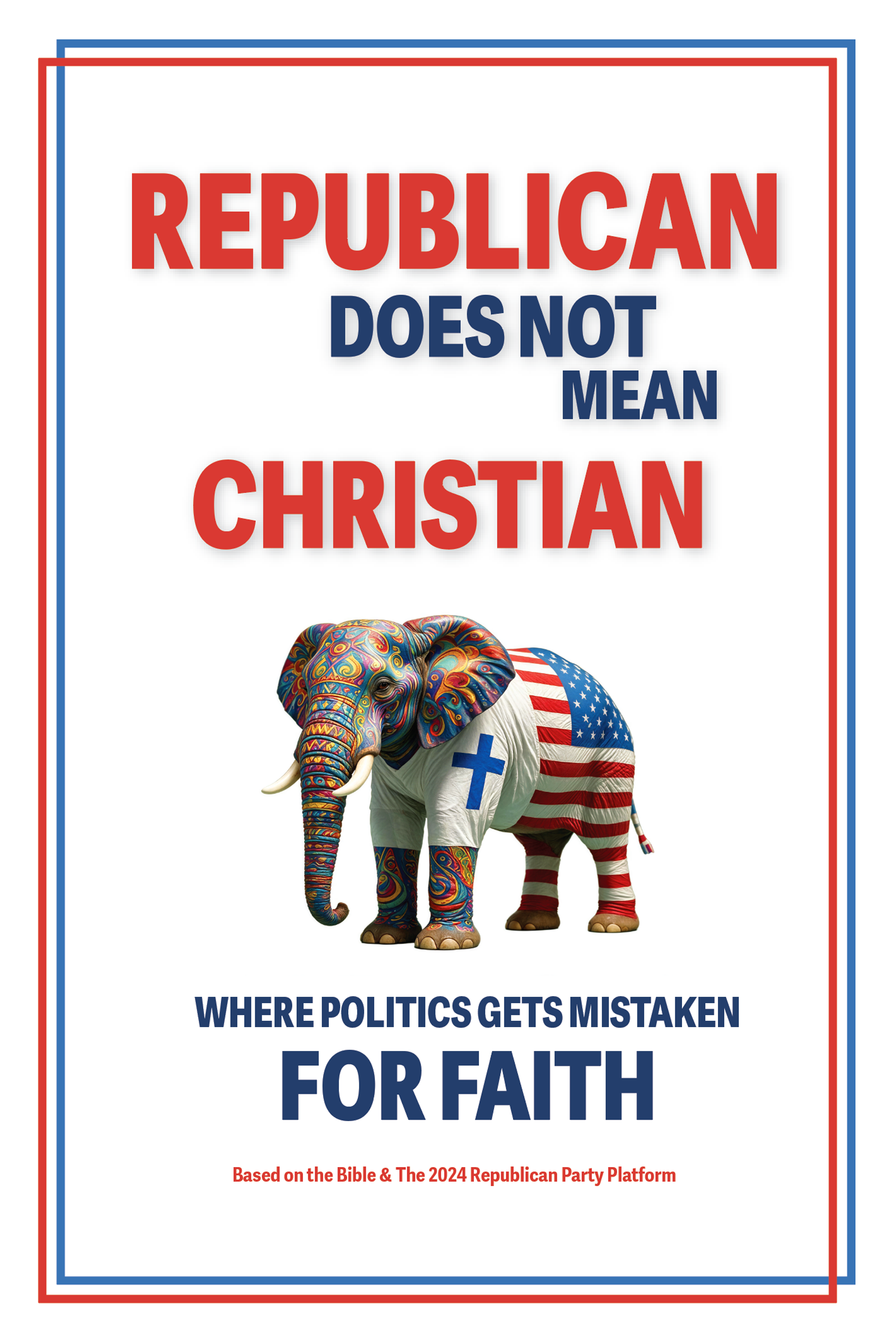
You are currently viewing this book

Click here to read the entire book one of this two-part series
Republican Does Not Mean Christian: Where Politics Gets Mistaken For Faith - Chapter 7
Based On The Bible & U.S. Republican Party Platform For 2024
Conclusion
Quick Links to Each Chapter
Now It’s Up To You
__________
We live in an age when politics has become far more than a disagreement over taxes, regulations, foreign policy, and the proper role of government. Political identity increasingly reaches into questions of morality, family, sexuality, education, religion, human life, national identity, justice, and even the meaning of truth. For Christians, that makes political participation unavoidable in one sense because many political decisions concern subjects on which Scripture has something important to say. But it also makes political participation spiritually dangerous because the closer politics moves toward questions of morality and faith, the easier it becomes to confuse a political coalition with Christianity itself.
That is why this book began with a simple question and has tried to remain faithful to it throughout: What has the Republican Party actually put in writing, and how does what it has written compare with what God has put in writing? We did not begin by asking whether Republican politicians are better people than other politicians, whether Republican voters are better Christians than other voters, or whether conservatism should be considered synonymous with Christianity. We did not attempt to define the Republican Party by thousands of comments made by individual politicians, commentators, activists, candidates, or voters. We examined the written platform because if we are going to say that a political party believes something, the fairest evidence is what the party itself has formally chosen to say it believes.
We applied an equally important standard to Scripture. Finding a political position that someone dislikes is not enough to establish a biblical contradiction. Scripture must actually speak clearly enough on the underlying moral question to support the claim being made. That distinction prevented us from turning ordinary political disagreements about taxes, tariffs, energy, immigration levels, government agencies, healthcare systems, military spending, education administration, and other modern policy questions into commandments from God. Scripture provides principles that can and should influence how Christians think about such matters, but applying a biblical principle to a modern policy question frequently requires additional human reasoning. That reasoning may be wise, well informed, and even strongly persuasive, but we should be careful about giving our reasoning the same authority as the Scripture from which we began.
The result of applying those standards is important because the examination did not produce a simple condemnation of the Republican Party. On several significant moral questions, the Republican platform contains positions that correspond with the biblical framework used throughout this book. Its defense of religious liberty, recognition of biological sex, support for parents and families, concern for unborn life, and other portions of the platform can reasonably be supported by Christians because of principles they find in Scripture. On many other subjects, the Bible supplies moral principles without supplying a detailed twenty-first-century American policy prescription. Faithful Christians can therefore sometimes reach different political conclusions while remaining equally committed to biblical authority.
We also found areas deserving continued scrutiny. The Republican platform says that it stands for life while expressly opposing late-term abortion and returning much of abortion policy to the states. For a Christian who believes human life possesses God-given dignity from conception, that raises a serious question about whether the stated political protection follows the underlying principle far enough. Yet honesty also requires acknowledging what the platform does not say. It does not expressly declare early abortion morally acceptable or establish abortion as a fundamental right. The concern is therefore legitimate, but the evidence does not justify transforming incomplete protection into an affirmative endorsement that the platform never makes.
IVF creates a similar question. The platform supports access to IVF, and the desire to have children is not something Christianity should treat casually or without compassion. Yet if human dignity begins at conception, Christians cannot simply stop the moral inquiry at the words “fertility treatment.” Practices involving the creation, storage, selection, transfer, freezing, and possible destruction of embryos can raise serious questions about human life. At the same time, support for IVF does not automatically mean support for every practice sometimes associated with IVF. Once again, the Christian obligation is to tell the truth in both directions: neither ignore a moral question because Republicans support the broader policy nor accuse Republicans of explicitly supporting something their platform does not actually say.
That distinction may be one of the most important lessons in this book. Christians do not serve truth by exaggerating the faults of a political party, and they do not serve truth by hiding them. We cannot manufacture biblical commands where Scripture leaves room for judgment, and we cannot manufacture political positions by inserting words into a platform that are not there. When Scripture speaks clearly, however, political loyalty must end where obedience to God begins. The standard cannot change according to whether the person, party, or policy being examined is something we oppose or something we support.
Christianity Is Not Whatever Christians Do
There is another distinction that must be made before reaching the final conclusion of this book, and it extends far beyond Republican politics. Christianity must be defined by Christianity itself, not by every person who claims to represent it. A politician can call himself a Christian. A pastor can call himself a Christian. A Republican, conservative, celebrity, business owner, neighbor, family member, or president can call himself a Christian. None of those declarations changes what Christianity teaches. Christians can lie while Christianity continues to teach that lying is wrong. Christians can commit adultery while Christianity continues to condemn adultery. Christians can act hatefully while Christianity continues to command love. Christians can become greedy, arrogant, dishonest, cruel, sexually immoral, or politically corrupt without Christianity becoming greedy, arrogant, dishonest, cruel, sexually immoral, or politically corrupt.
The failure of someone claiming to follow a standard is evidence about the person’s behavior; it is not automatically evidence about the standard itself. This should be obvious when applied outside religion. A doctor violating medical ethics does not demonstrate that medical ethics teach misconduct. A judge violating the law does not demonstrate that the law requires corruption. A parent failing to follow his own rules does not prove that the rules instructed him to fail. Yet when Christianity enters a political discussion, this distinction is frequently lost. Someone points to the behavior of a person who calls himself Christian and treats that behavior as though Christianity itself must somehow be responsible for it.
This is particularly common when discussing political leaders. The argument may be, “How can this person call himself a Christian when he lies?” or “How can Christians support someone who appears to violate the Ten Commandments?” Those are legitimate questions about conduct, consistency, character, and political judgment, but they must be separated from the question of what Christianity teaches. If a president lies, Christianity does not suddenly approve of lying. Exodus 20:16 commands against bearing false witness, and Colossians 3:9 tells believers not to lie to one another. If a politician commits adultery, the seventh commandment does not disappear. If a Christian behaves arrogantly, Scripture’s warnings concerning pride remain exactly where they were. The proper conclusion is not that Christianity teaches whatever the Christian happened to do. The proper conclusion may simply be that the person failed to live according to the Christianity he professes.
The Bible itself makes this distinction impossible to avoid because Scripture does not hide the sins of its own people. David committed adultery and arranged the circumstances leading to Uriah’s death. Peter denied Jesus three times. Moses disobeyed God. Abraham deceived others concerning Sarah. Paul openly acknowledged that he had persecuted the Church. Christianity has never taught that becoming Christian makes a person incapable of sin. First John 1:8 says, “If we say we have no sin, we deceive ourselves.” Romans 3:23 says that “all have sinned and fall short of the glory of God.” Consequently, demonstrating that a person who professes Christianity has sinned does not by itself disprove Christianity. In an important sense, it demonstrates something Christianity has been saying about humanity from the beginning.
None of this should become an excuse for hypocrisy. The fact that Christians sin does not make sin irrelevant, and political usefulness does not provide a moral exemption. If a politician lies, Christians should be able to say the lie was wrong without first checking whether the politician is someone they voted for. If a politician commits adultery, adultery does not become acceptable because that politician supports policies Christians favor. If someone falsely accuses another person, false witness does not become righteous because the accusation helps win an election. A Christian may still make a separate political judgment about whether an imperfect candidate is preferable to the available alternatives, but political support should never require redefining immoral behavior as morally acceptable.
This also means we should be cautious about making claims concerning another person’s salvation. Christianity does not teach that saying “I am a Christian” proves perfect obedience, nor does it teach that committing a sin automatically proves that someone could never genuinely believe in Christ. If perfect obedience were the qualification for Christianity, there would be no Christians. Christianity teaches salvation by grace through faith and calls believers to repentance and obedience, but human beings do not possess God’s complete knowledge of another person’s heart. We can compare observable conduct with Scripture and say when conduct is contrary to Christian teaching. We should be considerably more cautious about moving from “this behavior is contrary to Christianity” to “therefore I know with certainty that this person is not a Christian.” Those are not the same claim.
“Isn’t Christianity Supposed to Be About Love?”
Perhaps one of the most common statements made in disagreements about Christianity is, “Isn’t Christianity supposed to be about love?” The answer is unquestionably yes. Jesus identifies love for God and love for one’s neighbor as the two great commandments in Matthew 22:37–40.
—Matthew 22: 34-40
Jesus, who commanded love, also taught about truth, sin, repentance, forgiveness, obedience, judgment, sexual morality, hypocrisy, mercy, and eternal life. Those teachings are not exceptions to His command to love; they are part of the biblical framework within which love must be understood. Biblical love therefore cannot mean automatically affirming everything another person believes or does, because Jesus Himself loved people while calling them to repentance. At the same time, biblical truth cannot become an excuse for cruelty because the same Jesus who called people to repentance commanded His followers to love even their enemies. Christianity does not give us permission to choose truth without love or love without truth and then declare the half we selected to be the whole of Christianity.
This is one of the places where political arguments can go badly wrong. Someone quotes “love your neighbor” and treats the verse as though it automatically determines the correct immigration law, welfare program, healthcare system, tax structure, or government expenditure. Another person quotes Romans 13 concerning civil authority and treats it as though it settles every question about how immigrants, prisoners, protesters, or political opponents should be treated. Someone cites biblical concern for the poor and concludes that a particular government program must therefore be the Christian policy. Someone else cites biblical teaching about work, responsibility, and providing for one’s family and concludes that reducing the same program must therefore be the Christian policy. In each case, the biblical principle may be genuine while the specific political conclusion requires additional reasoning that does not come directly from the biblical text.
That is why Christians should distinguish carefully among biblical commands, biblical principles, and human policy judgments. Scripture commands Christians to love their neighbors. That is biblical. How the United States should structure a particular federal assistance program is a policy judgment that requires economic, social, administrative, and political reasoning Scripture does not specifically provide. Scripture commands justice toward the foreigner and condemns mistreatment of him. That is biblical. The number of immigrants the United States should legally admit each year is not stated in Scripture. Scripture condemns theft and teaches work, responsibility, generosity, compassion, and concern for the poor. Those are biblical teachings. The precise tax system that best balances those principles is not written in the Bible.
This does not mean Christianity has nothing to contribute to public policy. It means Christians should be honest about where Scripture ends and their application begins. A person may develop an excellent political argument from a biblical principle, but he should not automatically give every step of his political reasoning the same authority as the biblical principle itself. Saying, “I believe this is the wisest policy because of these biblical principles,” is different from saying, “God commands this particular policy.” The first statement leaves room for human judgment. The second claims divine authority and therefore requires much stronger biblical evidence.
When Christians Misrepresent Christianity
The consequences of getting this wrong extend far beyond political arguments. Some people have walked away from Christianity, or never seriously considered it, because what they encountered under the name of Christianity was hypocrisy, political tribalism, cruelty, misinformation, self-righteousness, or human political opinions presented as though God had personally dictated them. Others have encountered a version of Christianity reduced almost entirely to acceptance and affirmation and later discovered that difficult teachings concerning sin, repentance, obedience, and judgment had been left out. In both cases, a person may believe he has encountered Christianity when what he has actually encountered is someone’s selective reconstruction of it.
Christians should take that problem seriously rather than dismissing it. Saying “Christianity teaches this” is a much larger claim than saying “I believe this.” Saying “God requires this policy” is much larger than saying “I believe this policy best applies these biblical principles.” The first formulation invokes divine authority, while the second acknowledges human judgment. When Christians repeatedly erase that distinction, people outside Christianity can understandably come to believe that Christianity consists of whatever political opinions Christians happen to hold. This creates an especially tragic possibility. Someone may say, “I want nothing to do with Christianity because I see Christians lying, treating people badly, or defending politicians who behave immorally.”
Christians should not simply dismiss that reaction because hypocrisy can cause genuine damage and Christians should acknowledge it wherever it occurs. But the intellectually fair question cannot stop with, “What did someone calling himself a Christian do?” It must continue to the equally important question, “Did Christianity actually teach him to do it?”
If a Christian lies, compare the lie with Christianity and Christianity condemns it. If a Christian commits adultery, compare adultery with Christianity and Christianity condemns it. If a Christian hates his enemy, compare that hatred with Jesus’ teaching and Christianity corrects him. If a Christian becomes greedy, proud, cruel, dishonest, or unjust, the existence of the behavior does not demonstrate that Christianity produced it when Christianity itself condemns the behavior. The person’s actions may instead demonstrate that he failed to follow the standard he claimed to believe.
The same fairness must operate in the opposite direction. Before accusing a Christian of violating Christianity because he does not support a particular political program, first establish that Christianity actually requires that program. Not merely a verse containing the word poor, foreigner, justice, authority, nation, work, family, or love, but a sound biblical argument demonstrating that the teaching actually requires the specific modern conclusion being attributed to it. If several additional assumptions supplied by human political philosophy are necessary to reach the conclusion, then the more accurate statement may be, “I believe this policy best applies a Christian principle,” rather than, “This is what Christianity requires.”
That distinction could eliminate a great deal of unnecessary hostility between people who share Christian beliefs but disagree politically. More importantly, it could prevent people from rejecting Christianity because of doctrines Christianity never taught, political positions Scripture never required, or sinful behavior Christianity itself condemns.
Judge Christianity by Christ
Ultimately, Christianity should be judged by its source. If someone wants to know whether Christianity is true, the central question is not whether every Christian has behaved well, because they plainly have not. The question is not whether every pastor has been trustworthy, every church has acted honorably, every Christian politician has obeyed the Ten Commandments, or every person carrying a Bible has represented it accurately. Human failure is already one of Christianity’s foundational claims about humanity.
The more fundamental questions concern Jesus Christ. What did He teach? Who did He claim to be? What happened at the crucifixion? What explains the resurrection proclamation? What do the Scriptures actually teach when they are read in context rather than through political slogans? Those questions examine Christianity itself rather than merely examining people who sometimes fail to live according to it. As we discussed in the preceding chapter, Christianity places historical claims concerning Jesus, His crucifixion, and His resurrection at the center of the faith. The behavior of a twenty-first-century politician cannot make those historical claims true or false.
For the Christian, the same principle works in reverse. Do not begin by asking whether something sounds Republican and then search Scripture for support. Do not begin by asking whether something sounds compassionate and assume compassion automatically makes it Christian. Do not begin with a politician, party, movement, desired policy, or political identity. Begin with Scripture, read enough of it to understand what it actually teaches, distinguish clear commands from broad principles and broad principles from personal political judgments, and then work outward toward politics.
That approach will sometimes produce certainty and sometimes produce humility. Scripture may tell us clearly that something is wrong. It may tell us clearly that something is right. It may provide principles without prescribing the political mechanism through which those principles must be applied. Sometimes it may force us to admit that the Bible simply does not answer the particular policy question we desperately want it to answer. That is not a weakness in Christianity. It is a limitation upon us and upon the authority we have to place our own conclusions into God’s mouth.
A Republican Can Be a Christian Without Republicanism Becoming Christianity
Nothing in this examination requires treating Republican political identity as inherently incompatible with Christianity. A Christian may conclude that many Republican positions are consistent with his understanding of Scripture and may support Republican candidates for that reason. But saying that a Republican can be a Christian is very different from saying that Republicanism itself is Christian. Political parties are human institutions, shaped by changing coalitions, leaders, elections, and circumstances. Christianity cannot therefore be defined by where a political party happens to stand at a particular moment.
A Christian can say, “I am a Republican because I believe many of its present positions are consistent with my biblical convictions,” while keeping the order of authority clear. If those positions change, however, allegiance to Christ cannot be expected to change with them. The danger begins when that order is reversed and a political position is assumed to be Christian simply because Republicans support it—or because it is described with appealing words such as loving, compassionate, traditional, patriotic, conservative, progressive, inclusive, or just. For the Christian, the party may be supported when its positions correspond with Scripture, but it can never become the authority that defines what Scripture means.
You Still Have to Test Your Own Side
It is relatively easy to identify moral problems among people with whom we already disagree. The harder test comes when Scripture confronts someone we admire, a movement we belong to, or a political leader whose success we consider important. At that moment, the question is no longer whether we believe the Bible when it corrects someone else. The question is whether we believe it when it corrects us.
Scripture repeatedly warns against partiality, and that principle requires the standard to remain the same regardless of who stands before us. A lie does not become less false because it helps our political side. Cruelty does not become kindness because it is directed toward someone we consider dangerous. Arrogance does not become strength because the arrogant person advances policies we support, and sexual immorality does not become morally irrelevant because acknowledging it would be politically inconvenient. This does not mean every personal failing has equal political importance or that Christians cannot make difficult choices among imperfect candidates. It means we should be able to make those choices without pretending wrongdoing has become righteousness.
Scripture itself demonstrates this kind of honesty. David’s importance does not prevent Scripture from recording his adultery and his role in Uriah’s death. Moses’ greatness does not erase his disobedience, and Peter’s central role in the early Church does not remove the record of his denial of Christ. Scripture does not protect important people by rewriting their failures. Christians should be capable of the same distinction in political life: a leader can accomplish something valuable and still behave wrongly, a policy can be supported without making the person advancing it righteous, and a politician can receive someone’s vote without receiving unquestioning moral defense.
Your Political Party Is Not Your Church
A political party and the Church serve fundamentally different purposes. Political parties organize coalitions, nominate candidates, win elections, and attempt to implement public policy. The Church is called to make disciples, proclaim the gospel, teach, serve, forgive, pursue holiness, speak truth, love others, and remain faithful to Christ. Christians inevitably carry their convictions into public life, but winning elections is not the Great Commission.
Government can protect religious liberty, but it cannot create faith. A country can elect politicians whose policies Christians support while its people remain spiritually distant from God. It can display the Ten Commandments while ignoring them, defend Christmas while knowing little about Christ, or speak frequently about God while living as though He possesses no authority. Political success and spiritual faithfulness are therefore not the same thing.
This distinction becomes especially important when a party changes. The Republican platform examined in this book is a political document produced for a particular moment and, like party platforms generally, can be replaced by later platforms. If future Republican positions conflict with convictions a Christian believes Scripture clearly establishes, the Christian must still decide which authority governs his beliefs. Conversely, disagreement over matters Scripture does not specifically settle should not automatically be elevated into a theological dispute. The Christian must remain capable of distinguishing God’s commands from political judgment.
Second Timothy warns of people who will seek teachers who suit their own desires rather than endure sound teaching. That warning is easiest to apply to someone else. The more difficult question is whether we have surrounded ourselves with politicians, commentators, pastors, programs, podcasts, and friends who mostly confirm what we already believe. The Christian needs a standard outside himself and outside his political coalition precisely because both can be wrong. Christian courage therefore cannot mean only confronting the other side. It must include the willingness to test our own side—and ourselves—by the same standard.
The Choice That Remains
The choice at the end of this book is not simply Republican or Christian. Based upon the comparison made in these pages, that would go beyond what this examination established. A person can identify as Republican while following Christ and may conclude that numerous Republican positions correspond with his understanding of Scripture. The deeper question is what happens when the two no longer agree.
That question is worth answering before the disagreement arrives. Political platforms change, leaders change, coalitions change, and cultures change. If political success someday requires Christians to excuse something they once condemned, or if a party adopts a position they believe Scripture clearly rejects, which standard will remain fixed? At the same time, Christians should not turn every political disagreement into a spiritual crisis. Scripture does not prescribe every tax rate, immigration level, tariff, healthcare system, or government program. Christians can disagree about such questions without necessarily disagreeing about Christianity. The important distinction is between what Scripture actually establishes and the political judgments human beings make while attempting to apply it.
Joshua told Israel, “Choose this day whom you will serve” (Joshua 24:15), a statement made in the context of Israel choosing whether it would remain faithful to the Lord. It was not written about American politics, and it should not be treated as though it were. But the question of ultimate allegiance remains relevant for the Christian. Political involvement can be vigorous without becoming ultimate. Christians can vote, debate, support candidates, oppose policies, defend their convictions, and care deeply about their country while remembering that none of those activities defines Christianity.
There is also an important distinction for anyone who has become disillusioned with Christianity because of the conduct of Christians, churches, politicians, or political movements. When someone who calls himself Christian lies, acts hypocritically, behaves cruelly, misuses Scripture, or attaches God’s name to something God never said, compare that behavior with what Christianity actually teaches. Where Scripture condemns the behavior, distinguish the failure of the follower from the teaching of the faith. Before rejecting Christianity because of something done in its name, make certain that what you are rejecting is actually Christianity.
Hebrews 13:8 says, “Jesus Christ is the same yesterday and today and forever.” Political institutions cannot make that claim. Platforms change, candidates change, coalitions change, nations change, cultures change, and each of us changes. The 2024 Republican platform itself is a document adopted for a particular election cycle, not an unchanging statement of Christian doctrine. That is why the Christian needs an authority that does not move whenever politics does.
Read the platforms. Listen to the politicians. Examine the policies. Question the claims. Check the evidence. But read Scripture carefully enough to understand what it actually says, and do not use it merely to prove that someone else is wrong. Allow it to correct you as well. The responsibility of the Christian is not to make Christ fit the party, nor to turn every political preference into Christian doctrine, but to keep every human allegiance beneath the One allegiance Christianity says comes first: Jesus Christ.
Sources: Specific text assignment for each footnote in printed edition
-
Republican National Committee, The 2024 Republican Platform: Make America Great Again! 43rd Republican National Convention, 2024.
All sources identified as footnotes in printed text
Additional Matter Of Fact Books
Click image to find out more.

Matter Of Fact Books
Our books are priced to sell and change lives.