
God, Politics & Party
A Two-Part Series for Those Who Struggle With Where Politics Ends and Faith Begins
“Every generation faces its own battle for truth, and ours is no different. The danger today is not persecution from without, but deception from within. The most effective lies are not shouted in rebellion but whispered in the language of love, progress, and compassion. They sound noble, they feel kind, and they appear moral — yet they slowly replace obedience with emotion, and truth with tolerance.” — C. J. Bartels
Matter of Fact Books is making both books available to read free of charge for a limited time, in the hope that, if you identify as a Christian, you will truly understand what you have chosen to believe.
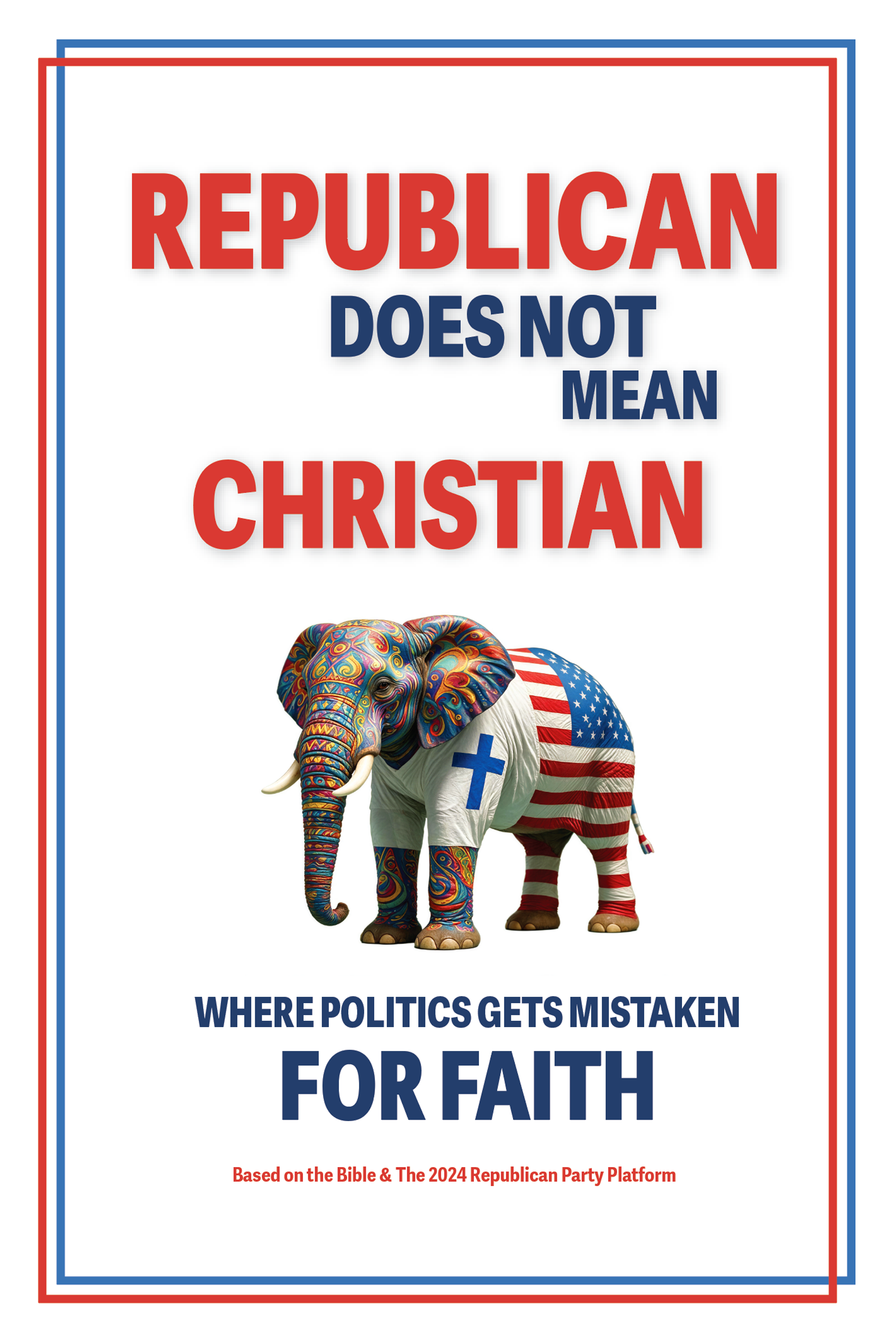
You are currently viewing this book

Click here to read the entire book one of this two-part series
Republican Does Not Mean Christian: Where Politics Gets Mistaken For Faith - Chapter 2
Based On The Bible & U.S. Republican Party Platform For 2024
The Republican Platform and the Biblical Meaning of Life
Quick Links to Each Chapter
Abortion, the States, and an Unresolved Question
__________
Of all the issues examined in the Republican Party platform, abortion may provide the clearest test of whether we are genuinely willing to allow Scripture to remain the standard even when a political party identifies itself with a biblical principle. The Republican platform approaches abortion by explicitly identifying Republicans with life, invoking constitutional protection for life, recognizing the authority of states to pass laws protecting those rights, and opposing late-term abortion. Those are meaningful statements. Under a Christian framework that recognizes unborn human life as possessing value before God, they move in the direction of protecting that life rather than denying its value. But identifying with a biblical principle does not place a political party beyond examination. If the principle is that unborn human life possesses moral value before God, the question is whether the political position follows that principle consistently.
The 2024 Republican Party Platform states that Republicans “proudly stand for families and Life.” It refers to the Fourteenth Amendment and its guarantee that no person can be denied life or liberty without due process, states that the power to legislate on abortion has been returned to the states and voters, and specifically says Republicans will oppose late-term abortion while supporting mothers and policies advancing prenatal care, access to birth control, and IVF. Those statements matter because they establish what the party actually chose to put in writing. They also establish the boundary of what can fairly be attributed to it. We should neither subtract from those words nor add conclusions the platform itself does not state.
The biblical argument concerning unborn life begins much earlier than the final months of pregnancy. Psalm 139:13–16 describes God as intimately involved in the formation of the child in the womb: “For you formed my inward parts; you knitted me together in my mother’s womb.” David does not describe himself as becoming known to God only after reaching a particular stage of development. His language presents continuity between the person speaking as an adult and the developing human being God formed before birth. Jeremiah 1:5 similarly records God’s words to Jeremiah: “Before I formed you in the womb I knew you, and before you were born I consecrated you.” The primary purpose of that passage concerns Jeremiah’s prophetic calling, but its language nevertheless assumes personal continuity before birth rather than treating prenatal existence as morally meaningless.
Luke 1 provides an especially interesting New Testament example. When Mary visits Elizabeth, John responds from within Elizabeth’s womb to the presence of the pregnant Mary, and Elizabeth subsequently refers to Mary as “the mother of my Lord.” Whatever conclusions someone may draw concerning the precise biological moment at which human life begins, the biblical narrative does not portray unborn human beings as objects whose value is created by the wishes of their parents or by government recognition. The womb is repeatedly presented as a place in which God is already at work, and the unborn are spoken of within a framework of personal identity, divine knowledge, and God’s creative activity.
That creates a difficulty for any political distinction that treats the moral value of unborn life as though it changes according to gestational stage. If the unborn child possesses human value before God, then the fundamental difference between an abortion at ten weeks and an abortion at thirty weeks cannot simply be that one involves a valuable human life and the other does not. Development is obviously different. Viability may be different. Medical circumstances can be dramatically different. But if the underlying moral subject is already a human life, the child’s fundamental value cannot logically appear simply because enough weeks have passed.
The Republican platform therefore deserves to be described accurately for explicitly identifying itself with life and for opposing late-term abortion. Those positions matter under the biblical framework being used in this book. But the platform also leaves an important question unresolved. If unborn human life is entitled to protection because it is human life, why should the extent of that legal protection ultimately depend upon the state in which the child happens to have been conceived? Constitutionally and politically, there can be arguments concerning which level of government possesses authority to regulate abortion. Biblically, however, the moral status of the unborn child cannot change when a mother crosses a state line. If deliberately ending innocent human life is morally wrong, a majority vote cannot change the underlying moral character of the act.
This distinction between legal authority and moral authority is essential. Governments regularly maintain different laws, and Scripture recognizes legitimate civil government. Romans 13:1–4 describes governing authorities as possessing a legitimate role in maintaining order and responding to wrongdoing. Nothing in Scripture requires every nation, state, province, or local government to maintain identical laws. But Romans 13 does not teach that whatever a government permits thereby becomes morally acceptable. Human government possesses legitimate legal authority within its proper sphere, but it does not possess the authority to rewrite God’s moral law.
The Bible provides numerous examples of this distinction. Pharaoh possessed political authority, yet his command concerning Hebrew infants was evil. Nebuchadnezzar possessed enormous political authority, yet Shadrach, Meshach, and Abednego refused his command to worship the golden image. Darius’s decree carried the force of law, yet Daniel continued praying to God. When governing authorities ordered the apostles to stop teaching in the name of Jesus, Peter and the apostles answered in Acts 5:29, “We must obey God rather than men.” Scripture therefore recognizes government without making government the source of morality. Political authority can determine what is legally permitted within a jurisdiction, but it cannot determine what God declares morally right.
Returning abortion policy to the states therefore answers one kind of question without necessarily answering the Christian moral question. A Christian may believe there are constitutional reasons for state authority over abortion legislation. That is a political and constitutional argument. But if abortion involves the taking of innocent human life, the Christian cannot conclude that the underlying act becomes morally acceptable merely because voters in a particular state approve it. A state’s authority to enact a law and the moral correctness of that law are separate questions.
This creates a real tension within the Republican platform. On one hand, the party invokes constitutional protection for life and expressly identifies itself with that principle. On the other hand, it accepts a political arrangement in which the extent of legal protection for unborn life can vary substantially from state to state. A Christian who accepts the first premise—that unborn human life deserves protection—should at least ask whether the second position follows consistently from it. If the right being discussed is truly a right to life, then geography and majority vote create an uncomfortable basis for determining how extensively that right will be protected.
But this is precisely where the evidentiary standard established earlier in this book prevents us from going too far. The Republican platform does not say that early abortion is morally good. It does not say that unborn children before a particular gestational age lack human value. It does not declare abortion a fundamental right, nor does it say that a state should permit early abortion. Instead, it identifies the political and constitutional mechanism through which abortion laws are to be determined and specifically states opposition to late-term abortion.
For that reason, the platform can reasonably be questioned from a consistently conception-based pro-life Christian perspective as insufficient, but insufficiency is not automatically contradiction. A Christian may believe the party should seek legal protection for unborn life beginning at conception and conclude that the Republican platform stops short of carrying its stated principle to that conclusion. That is a serious criticism. Yet saying that the platform fails to protect unborn life as completely as a particular biblical pro-life interpretation would require is different from saying that the platform affirmatively declares the destruction of unborn life to be morally acceptable. The written evidence does not permit those two statements to be treated as interchangeable.
That distinction may be frustrating because political discussion often demands simple categories: pro-life or pro-choice, biblical or unbiblical, right or wrong. But political platforms frequently contain compromises, jurisdictional arguments, coalition-building language, and positions designed to accommodate voters who do not agree completely with one another. A Christian examining such a document should not automatically call every political compromise sin, but neither should political practicality prevent the Christian from recognizing when a compromise appears to stop short of a moral principle the party itself claims to believe.
The question for Republicans who accept a conception-based understanding of human life is therefore worth stating plainly: If the unborn child possesses a right to life, what makes the extent of that right’s legal protection dependent upon geography or majority vote? The Republican platform does not fully answer that question. Its language establishes an identification with life and an explicit opposition to late-term abortion, but that very commitment creates a moral standard against which its more limited abortion position can be examined. The result is not an explicit platform endorsement of what Scripture condemns, but it is a significant unresolved question about whether the party has followed its own stated principle of life as far as that principle logically leads.
IVF and the Meaning of Conception
The platform’s support for in vitro fertilization makes the question still more complicated. Republicans explicitly support access to IVF. For families who have struggled with infertility, IVF can represent the possibility of having a child they desperately desire. That desire should not be dismissed casually. Infertility can bring tremendous grief, and Scripture itself contains painful accounts involving Sarah, Rachel, Hannah, and Elizabeth, all of whom experienced the anguish associated with being unable to conceive. The longing for children is not something Christianity treats as trivial, and a Christian examination of IVF should begin with compassion for the people facing that struggle rather than treating them merely as participants in an abstract ethical debate.
The moral difficulty arises not from the desire for children but from what Christians believe occurs at conception. If conception produces a new human life, the location of that conception cannot determine its value. An embryo conceived in a laboratory cannot possess less human dignity than an embryo conceived naturally simply because one temporarily exists outside the womb. If the biblical pro-life argument rests upon the proposition that human life begins at conception, then consistency requires Christians to consider seriously what happens to embryos created through reproductive technology.
IVF describes a broad medical process rather than one single moral act. Procedures and practices can differ. Embryos may be created, transferred, frozen, tested, preserved, donated, or under some circumstances discarded. That is why simply saying “IVF is abortion” would be far too broad. A couple might pursue fertility treatment while attempting to protect every embryo created. Other circumstances may involve embryos that are deliberately destroyed or permanently abandoned. Those situations cannot automatically be treated as morally identical simply because they occur within the broad category of IVF.
The Republican platform does not address those distinctions. It supports IVF but does not define what protections should apply to embryos created through the process. That omission becomes significant because the same platform identifies Republicans with life. If embryonic human life is protected because human dignity begins at conception, then reproductive technology presents the same fundamental moral question encountered in pregnancy: What obligations do we have toward the human life that has already begun?
Here again, however, the evidentiary standard protects us from claiming more than the document supports. The platform does not endorse embryo destruction. It does not state that unused embryos may be discarded without moral concern. It does not deny that an embryo is human life. It simply states support for IVF without addressing those questions. We therefore cannot make embryo destruction a Republican Party position merely because embryo destruction can occur in some IVF practices. To do so would violate the platform-only standard by replacing what the party actually wrote with an implication we supplied ourselves.
What we can say is that the Republican platform leaves an important question unanswered. Its stated commitment to life and its broad commitment to IVF coexist without explaining how potential conflicts between those principles should be resolved. For a Christian who believes human life begins at conception, that is not a minor technical question. It reaches directly into the meaning of the word “Life” that the platform itself chose to emphasize. If the moral protection of human beings begins at conception, then a coherent pro-life ethic must eventually address not merely conception inside the womb but human embryos created outside it.
This brings us back to the distinction between a contradiction and a tension. If the Republican platform stated that human life begins at conception and then explicitly authorized the deliberate destruction of unwanted embryos, the contradiction would be straightforward. If it declared embryonic life worthy of protection in one setting while expressly approving its deliberate destruction in another, we would have clearer language to examine. But that is not what the document says. It identifies Republicans with life, supports IVF, and leaves the relationship between those positions largely unexplained.
A fair biblical examination must therefore resist two opposite temptations. A Republican Christian should not reason that because the Republican Party describes itself as standing for life, every reproductive policy it supports must automatically be biblical. The label does not settle the moral question. At the same time, a critic should not reason that because some IVF practices result in embryo destruction, the Republican Party has therefore officially endorsed embryo destruction. That conclusion goes beyond what the platform says. In both cases, political assumptions would be replacing the written evidence.
The honest conclusion is more precise. The Republican platform expresses a commitment to life that corresponds significantly with a conception-based biblical pro-life framework, but it does not carry that principle through every question created by abortion law and modern reproductive technology. Its abortion language leaves the extent of protection partly dependent upon states and voters, while its IVF language leaves unanswered what protection should be afforded to embryos created through fertility treatment. Those omissions deserve serious scrutiny from Christians who believe human dignity begins at conception. But the written evidence supports describing them as unresolved biblical tensions rather than explicit biblical contradictions.
That distinction matters because the purpose of this book is not to make Republican politics appear more Christian or less Christian than the evidence allows. If the platform explicitly embraced something Scripture clearly condemns, the conclusion should be stated plainly. If it clearly embraces something consistent with Scripture, that should also be acknowledged. Here the evidence leads somewhere between those outcomes. The Republican platform identifies itself with life, but its treatment of abortion and IVF leaves important questions about how consistently that principle is applied. A Christian can recognize that incompleteness without pretending the platform says something it does not.
That may be the most useful lesson these two issues provide. A political party can move substantially toward a biblical principle without becoming the authority that defines the principle. It can use the word life while still leaving Christians with questions about what that word requires. The Christian’s responsibility is therefore not to begin with the political label “pro-life” and assume the moral work has been completed. It is to begin with the meaning and value of human life before God and then ask whether every political position—including one supported by a party with which the Christian often agrees—remains consistent with that standard.
Sources: Specific text assignment for each footnote in printed edition
-
Republican National Committee, The 2024 Republican Platform: Make America Great Again! 43rd Republican National Convention, 2024, 20.
-
American Society for Reproductive Medicine, Assisted Reproductive Technologies: A Guide for Patients (Birmingham, AL: American Society for Reproductive Medicine).
All sources identified as footnotes in printed text
Additional Matter Of Fact Books
Click image to find out more.




Matter Of Fact Books
Our books are priced to sell and change lives.