
If You Consider Yourself a Christian and Also a Republican, This Book Is for You
If the title of this book makes you uncomfortable, it is important to understand what it does—and does not—claim. Republican Does Not Mean Christian does not say that a Republican cannot be a Christian. It makes a simpler point: being Republican does not make someone Christian, and a political belief does not automatically become a Christian belief simply because Christians or Christian leaders support it.
Christianity is defined by Jesus Christ and Scripture, not by a political party, candidate, or movement. A politician who calls himself Christian can still act contrary to Christian teaching, just as a political position can reflect biblical principles without being specifically commanded by the Bible. This distinction matters because politics is often presented as Christianity when Scripture itself may leave room for judgment and disagreement.
This book is not an endorsement or condemnation of any political candidate, party, or voter. It compares positions expressed in the official Republican Party platform with the teachings of the Bible, identifying where they align, where questions remain, and where political preferences are sometimes mistaken for Christian doctrine.
This book is not an endorsement or condemnation of any political candidate, party, or voter. It compares positions expressed in the official Republican Party platform with the teachings of the Bible, identifying where they align, where questions remain, and where political preferences are sometimes mistaken for Christian doctrine.
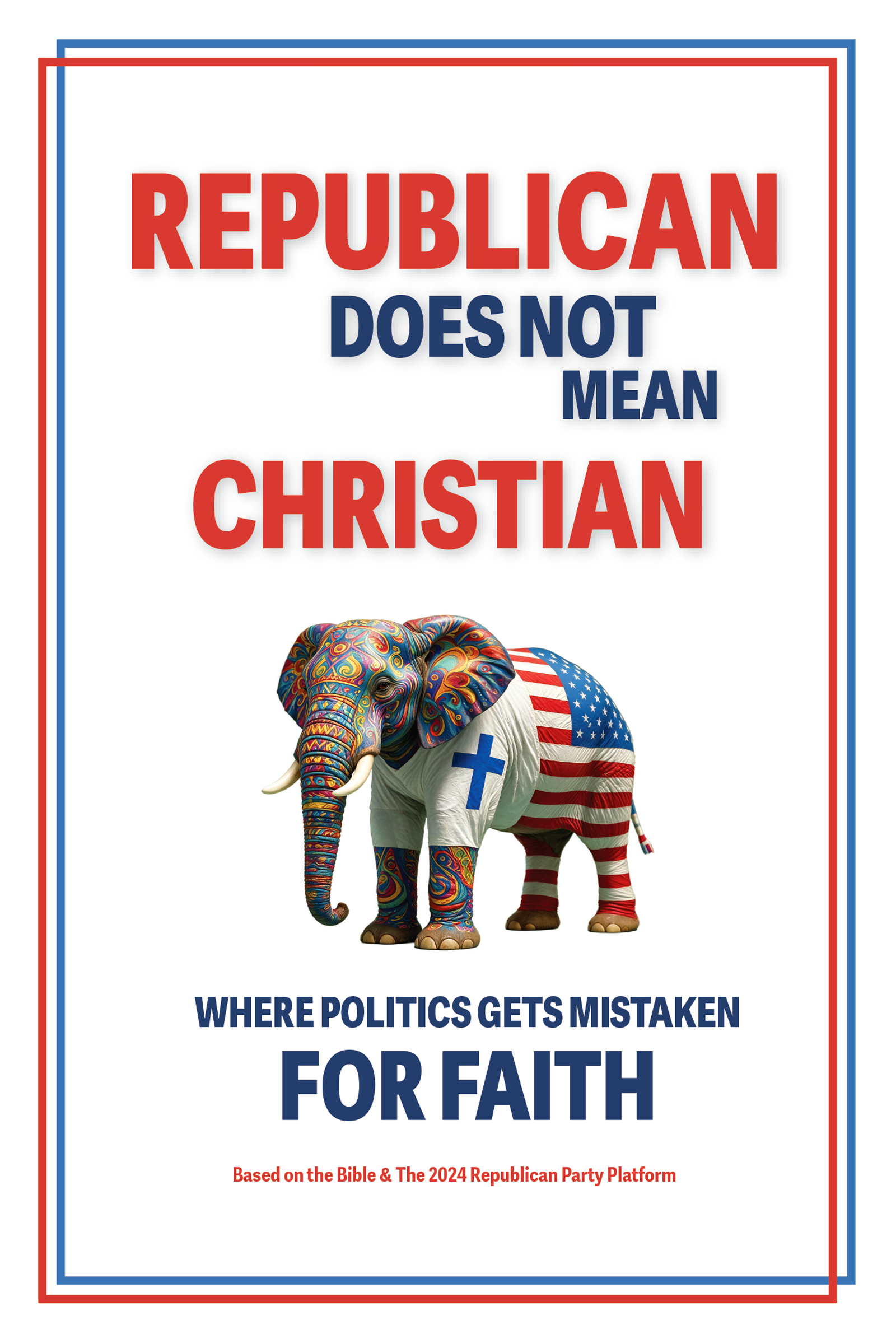
Why This Book Was Written
Christianity has become so intertwined with American politics that people on opposing sides increasingly use it to define not only themselves, but one another. One side may argue that Christianity is fundamentally about love, compassion, inclusion, and care for the vulnerable, and therefore conclude that those who support stricter laws, borders, or traditional moral boundaries are acting contrary to Christ. Republicans and conservatives may answer with a different list—life, family, personal responsibility, religious liberty, law and order, and traditional morality—and conclude that these positions place them naturally on the Christian side. Both approaches can make the same fundamental mistake: they can begin with a political worldview and then use selected parts of Christianity to validate it.
That is why this book was written. Christianity is not defined by what Republicans believe any more than it is defined by the accusations made against them. It is defined by Christ and the teachings of Scripture. Love is unquestionably Christian, but the Bible defines what love means and places it alongside truth, repentance, obedience, justice, mercy, forgiveness, and holiness. In the same way, defending life, marriage, family, religious liberty, or personal responsibility may correspond with biblical teaching, but agreement on those issues does not transform an entire political philosophy into Christianity. A person can be right about several biblical issues and still allow politics, nationalism, a political leader, or party loyalty to occupy a place that belongs to God.
There is another problem that has become increasingly important. Too many political disagreements are described as disagreements about Christianity when Scripture never actually settles the political question being debated. The Bible commands Christians to care for the poor, love their neighbors, treat the foreigner justly, tell the truth, respect legitimate authority, work, give generously, defend the vulnerable, and reject partiality. But those commands do not automatically establish a particular tax rate, immigration quota, welfare program, healthcare system, tariff, energy policy, military budget, or size of government. Human beings must reason from biblical principles to many modern policies, and that reasoning should not be given the same authority as the Word of God.
The Republican Party therefore provides an important test. Its official platform contains positions that correspond closely with biblical principles, others that belong primarily to political judgment, and some that raise serious questions when examined more closely. The purpose of this book is not to make those categories equal or manufacture contradictions where Scripture does not provide them. It is to ask what the Republican Party actually says, what the Bible actually says, and where human beings have added something of their own.
This distinction matters far beyond politics because people are increasingly judging Christianity by the behavior and opinions of people who claim its name. A Christian who lies does not make lying Christian. A politician who commits adultery does not change what Christianity teaches about adultery. Likewise, a person who attaches a Bible verse to a political policy has not necessarily established that policy as Christian doctrine. Before accepting or rejecting something because it has been called “Christian,” we should first ask a much more important question: Did God actually say it?
That is the purpose behind Republican Does Not Mean Christian. Under the standard used in this book, you can be a Republican and a Christian because the Republican platform does not explicitly require you to affirm something that Scripture clearly condemns. That does not make the Republican Party Christian, nor does it make every Republican policy biblical. Some positions align closely with Scripture, some raise serious questions, and many involve political judgments on which the Bible does not prescribe a specific modern policy.
More importantly, Christianity is not determined by a party label. Everyone is invited to follow Christ, but following Christ means allowing Him to identify what must change in us. Christians still sin, fail, and sometimes live inconsistently with what they profess. The answer is not to redefine Christianity around our behavior or politics, but to recognize the conflict, repent, and turn back toward Christ. Republican, Democrat, or anything else, the standard does not move to accommodate us. We are the ones called to move toward Christ.
Index
- Why – (4)
- the Republican party – (16)
- IDENTIFYING YOURSELF AS “OF THE WORLD” OR “OF GOD” – (26)
- THE REPUBLICAN PLATFORM AND THE BIBLICAL MEANING OF LIFE – (45)
- GOD’S WORD & HOW IT CHANGES WITH TIME – (57)
- THE ART OF DECEPTION – (75)
- Anchored In More Than Faith – (94)
- Conclusion & Notes To readers – (116)
Consider This...
Watch the video below without defending the person in it and without thinking about which political party he represents. Then ask a much simpler question: Does what you just heard reflect the teachings of Christianity? If the answer is no, Christianity itself agrees with you. Scripture does not suddenly redefine sexual morality, respect for women, adultery, lust, truthfulness, or self-control because the person involved is a Republican, a president, or someone supported by millions of Christians.
Watch the Access Hollywood Video…
A Christian may still make a separate political judgment about whether to vote for an imperfect candidate. Christians may disagree about how much a person’s character should weigh against policies, appointments, alternatives, or other considerations. But none of those political calculations changes Christian doctrine. Supporting someone’s candidacy does not require rewriting Christianity to make everything that person has done morally acceptable.
This matters especially for someone who has become disillusioned with Christianity because of Christians. If you have watched hypocrisy, dishonesty, sexual misconduct, arrogance, cruelty, or other wrongdoing committed or defended by people calling themselves Christians, you have every right to ask whether their conduct is consistent with what they profess. But before rejecting Christianity because of them, take one additional step: compare their behavior with Christianity itself. You may discover that the faith you thought their behavior disproved is the very standard that condemns what bothered you in the first place.
Do not judge Christ by whether every person carrying His name behaves like Him. Judge Christianity by Christ. Then judge the rest of us—including our politicians—against that standard.
Question: “Are the values expressed in the video and the teachings found in Scripture compatible?
No. If the conduct or values expressed in the video contradict what Scripture teaches, Christianity does not excuse them simply because the person identifies as Christian or is supported by Christians. The biblical standard does not change according to the person, political party, or circumstance. The failure belongs to the person who violates the standard—not to the standard itself.
Sample From Book
Christianity Is Not Whatever Christians Do
Index
- Why – (4)
- the Republican party – (16)
- IDENTIFYING YOURSELF AS “OF THE WORLD” OR “OF GOD” – (26)
- THE REPUBLICAN PLATFORM AND THE BIBLICAL MEANING OF LIFE – (45)
- GOD’S WORD & HOW IT CHANGES WITH TIME – (57)
- THE ART OF DECEPTION – (75)
- Anchored In More Than Faith – (94)
- Conclusion & Notes To readers – (116)
From the book “Republican Does Not Mean Christian – Where Politics Gets Mistaken For Faith”
__________
One of the greatest sources of confusion in political arguments about Christianity is surprisingly simple: Christianity must be defined by Christianity itself, not by every person who claims to represent it. A politician can call himself a Christian. A pastor can call himself a Christian. A Republican, conservative, celebrity, president, or ordinary voter can call himself a Christian. That declaration does not give that person the authority to redefine Christianity. Christians can lie, commit adultery, act arrogantly, become greedy, treat people unjustly, hate their enemies, and violate the very teachings they profess to believe. When they do, their failure does not change the standard. It demonstrates that they have failed to live according to it.
This distinction becomes especially important when people ask questions such as, “How can this person call himself a Christian when he lies?” or “How can Christians support someone who appears to violate the Ten Commandments?” Those are legitimate questions about conduct, character, consistency, and even political judgment, but they are not the same question as whether Christianity teaches the behavior being criticized. If a president lies, Christianity still condemns lying. If a politician commits adultery, Christianity does not suddenly approve of adultery. If someone behaves arrogantly, cruelly, dishonestly, or unjustly while identifying as Christian, Scripture remains capable of condemning that behavior regardless of the person’s political importance.
The Bible itself makes this distinction unavoidable because it does not present its own followers as morally flawless. David committed terrible sins. Peter denied Christ. Moses disobeyed God. Abraham failed morally. Paul openly described his own struggle with sin. Christianity never teaches that becoming a Christian makes someone incapable of wrongdoing. Scripture says that “all have sinned and fall short of the glory of God” (Romans 3:23), and 1 John warns that if we claim to be without sin, we deceive ourselves. Christianity therefore contains within itself the standard by which Christians can be shown to be acting contrary to Christianity.
That does not provide an excuse for hypocrisy. Political usefulness does not create a moral exemption, and supporting a politician does not require Christians to pretend that everything the politician says or does is morally acceptable. A Christian may make a political judgment that an imperfect candidate is preferable because of policies, appointments, alternatives, or other considerations. Another Christian may reach a different political judgment. What neither person should do is change the meaning of Christianity to make the candidate’s wrongdoing disappear. There is an important difference between choosing an imperfect political leader and declaring that the leader’s imperfections are no longer morally significant.
There is also an important limit to how far we should take these judgments. Saying, “This behavior contradicts Christianity” is different from saying, “Therefore I know this person is not a Christian.” We can compare observable conduct with Scripture because Scripture gives us a standard by which conduct can be evaluated. Determining the ultimate condition of another person’s relationship with God is a different matter. Christianity calls people to repentance precisely because Christians themselves continue to need correction, forgiveness, and transformation.
Isn’t Christianity Suppose To Be About Love?
One of the most common objections raised in political discussions is that Christianity is supposed to be about love. That is correct. Jesus placed love of God and love of neighbor at the center of His teaching in Matthew 22:37–40, and the New Testament repeatedly emphasizes love as essential to Christian life. But the word love cannot be removed from the rest of Scripture and then filled with whatever political or cultural meaning we prefer. Jesus taught love alongside truth, repentance, forgiveness, obedience, mercy, judgment, holiness, and the reality of sin. Biblical love cannot be used to eliminate those teachings any more than biblical truth can be used as an excuse for cruelty.
This becomes particularly important when biblical principles are applied to modern political questions. “Love your neighbor” does not by itself establish a particular immigration system, welfare program, healthcare policy, or tax rate. The biblical command to treat the foreigner justly does not tell Congress exactly how many people should legally enter the United States each year. Scripture’s concern for the poor does not establish one particular government program, just as its teachings about work and personal responsibility do not establish that the same program must be eliminated. These may all be important political questions, and biblical principles can legitimately influence how Christians think about them, but the human reasoning that connects a biblical principle to a particular modern policy should not automatically be given the authority of Scripture itself.
That distinction allows Christians to speak much more carefully. Instead of saying, “God commands this particular policy,” it may sometimes be more accurate to say, “I believe this policy is the wisest way to apply these biblical principles.” The first statement claims divine authority for the policy itself. The second acknowledges that Scripture establishes the principle while human beings are reasoning about its application. Sometimes Scripture establishes a clear moral boundary. At other times it gives us principles requiring wisdom. Confusing those categories is one of the easiest ways politics gets mistaken for faith.
One Verse Does Not Automatically Make Something Christian
Almost any political argument can be made to sound Christian if someone is allowed to select one Bible verse and attach it to a modern policy. The verse itself may even be quoted correctly while its political application is poorly supported. Before declaring something “the Christian position,” we should ask what the passage actually means, whether the principle appears consistently elsewhere in Scripture, whether other passages qualify its application, who the original instruction was directed toward, and how many human assumptions have been inserted between the biblical text and the political conclusion.
A command for individual Christians to give generously, for example, does not establish an exact federal tax rate. Scripture’s recognition of civil authority does not mean that every government action is righteous. Commands concerning the treatment of strangers do not establish an immigration quota. Concern for the poor does not establish one welfare system, just as teachings about work and responsibility do not establish one economic system. Human reasoning may produce thoughtful answers to all of these questions, but thoughtful human reasoning is still not the same thing as Scripture.
There are, of course, areas where Scripture speaks far more directly. False witness, adultery, theft, hatred, injustice, sexual immorality, and idolatry are not merely modern political policy questions. Scripture repeatedly addresses them as moral matters. In the same way, Christians are repeatedly commanded to practice love, forgiveness, generosity, truthfulness, justice, mercy, and faithfulness. The important distinction is between what Scripture actually establishes and what human beings subsequently attach to it.
When Christians Misrepresent Christianity
This distinction matters because some people have rejected Christianity not primarily because of what Christ taught, but because of what they have encountered under the name of Christianity. They have seen hypocrisy, political tribalism, dishonesty, cruelty, self-righteousness, misinformation, or human political opinions presented as though they came directly from God. Those experiences should not simply be dismissed. Christians who behave contrary to what they profess can seriously damage the credibility of their witness.
But fairness requires one additional question. When someone calling himself a Christian lies, behaves immorally, acts cruelly, becomes greedy, treats others unjustly, or excuses wrongdoing because it benefits his political side, we should ask not only, “Did a Christian do this?” but also, “Did Christianity teach him to do it?” If Christianity itself condemns the behavior, then the person’s failure is evidence that he violated Christianity, not evidence that Christianity teaches the failure.
The same fairness should operate in the opposite direction. Before accusing someone of being unchristian because he does not support a particular government program, immigration policy, economic proposal, or other political solution, we should first establish that Christianity actually requires that solution. A verse containing words such as poor, foreigner, justice, authority, nation, work, family, or love does not automatically settle a twenty-first-century policy debate. If additional human assumptions are required to move from the biblical command to the political policy, we should acknowledge them rather than presenting our own conclusion as though God wrote it Himself.
This distinction could remove a great deal of unnecessary hostility from discussions about Christianity and politics. More importantly, it could prevent people from rejecting Christianity because of doctrines Christianity never taught or behavior Christianity itself condemns. Before deciding that Christianity is hypocritical, hateful, political, or inconsistent because of something done by a person carrying its name, compare that person’s words and actions with the teachings of Christ. You may discover that the very Christianity you thought the person represented is the standard by which his behavior should have been challenged in the first place.
Judge Christianity By Christ
Christianity should ultimately be judged by its source, not by the behavior of every person who claims its name. The central Christian questions concern who Jesus was, what He taught, whether He was crucified, whether He rose from the dead, and whether the Scriptures that testify about Him are trustworthy. The conduct of a modern politician cannot make those historical claims true, and the misconduct of a modern politician cannot make them false.
The same principle should govern Christians when they enter politics. We should not begin with the position we already want—Republican, conservative, compassionate, patriotic, traditional, progressive, or otherwise—and then search Scripture for a verse capable of defending it. We should begin with Scripture, understand its teachings in context and alongside the rest of Scripture, distinguish clear commands from broad principles and human judgments, and only then ask how those teachings should affect our politics. Sometimes that process will produce certainty. Sometimes it will require humility. Sometimes the most biblically responsible answer may simply be that Scripture does not prescribe the exact political solution being debated.
That is not a weakness in Christianity. It is a recognition of the limits of our own authority. Christianity does not need to answer every question Congress debates in order to provide a moral foundation for the Christian life. What it does require is that Christians never give their political judgments the authority that belongs to God, and that critics of Christianity distinguish between what Christ actually taught and what imperfect Christians have done in His name.
Matter Of Fact Books Highlighted Series
Click image to find out more.
For Atheists, Agnostics, or even theChristian that wants to discover why belief in a creator is more rational than you may think.
For anyone seeking to discover whether all religions lead to God—or whether one alone reveals who He truly is.
For anyone seeking to discover why the greatest obstacle to knowing God may not be disbelief—but pride.
Additional Matter Of Fact Books
Click image to find out more.

Matter Of Fact Books
Our books are priced to sell and change lives.