
God, Politics & Party
A Two-Part Series for Those Who Struggle With Where Politics Ends and Faith Begins
“Every generation faces its own battle for truth, and ours is no different. The danger today is not persecution from without, but deception from within. The most effective lies are not shouted in rebellion but whispered in the language of love, progress, and compassion. They sound noble, they feel kind, and they appear moral — yet they slowly replace obedience with emotion, and truth with tolerance.” — C. J. Bartels
Matter of Fact Books is making both books available to read free of charge for a limited time, in the hope that, if you identify as a Christian, you will truly understand what you have chosen to believe.
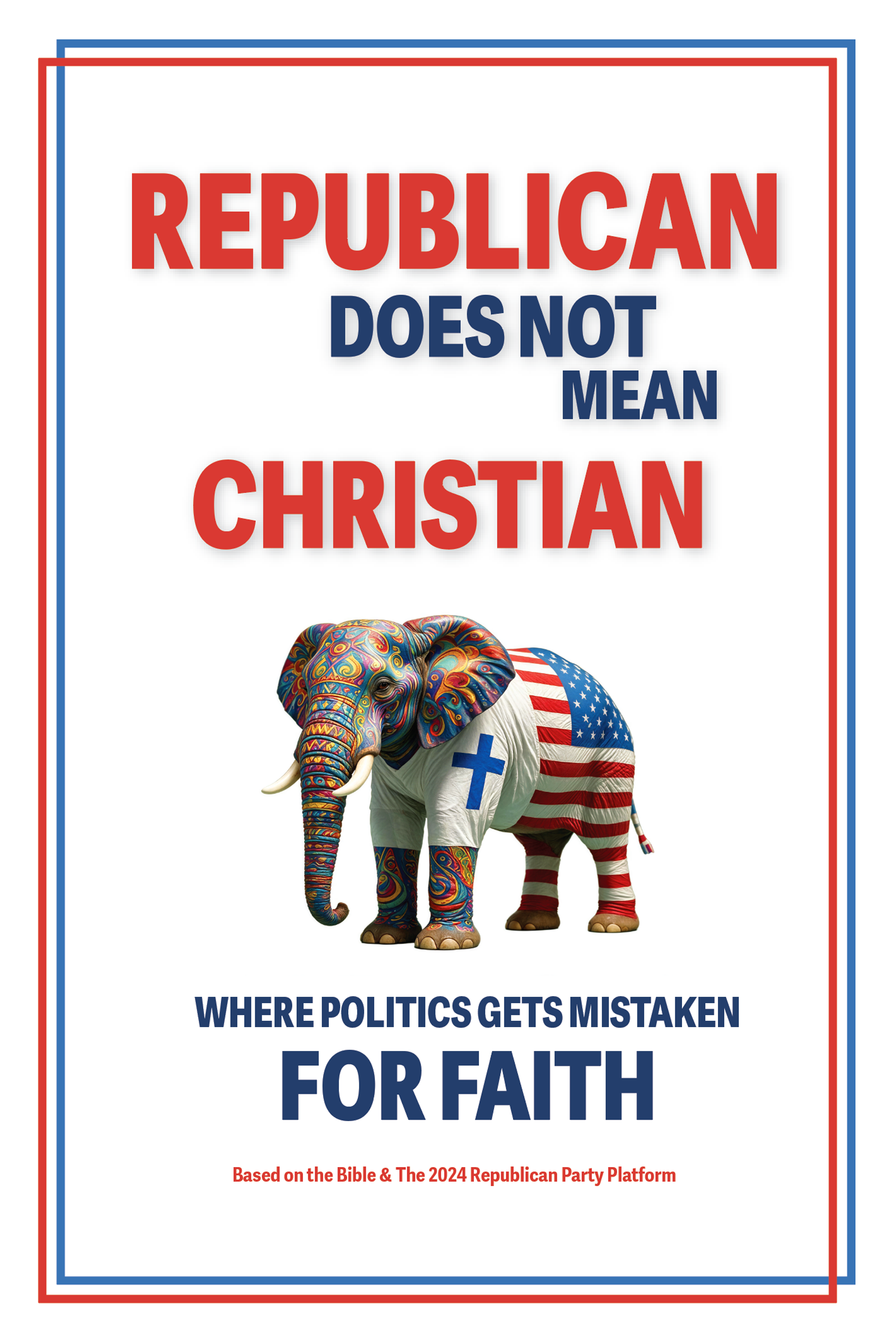
You are currently viewing this book

Click here to read the entire book one of this two-part series
Republican Does Not Mean Christian: Where Politics Gets Mistaken For Faith - Chapter 1
Based On The Bible & U.S. Republican Party Platform For 2024
Why
Quick Links to Each Chapter
__________
Christianity has always shaped the way many Americans think about politics—not by providing a detailed political platform, but by providing a moral framework through which questions of justice, human dignity, life, responsibility, truth, and authority can be examined. Was the Constitution perfect? Were the people who wrote it perfect? Of course not. But the principles that shaped the nation developed within a culture deeply influenced by biblical ideas about human nature, moral law, individual responsibility, and the belief that human rights do not originate merely from government. For Christians, however, the important question is not whether a political position is conservative or liberal, popular or unpopular, Republican or otherwise. The more important question is whether the principle being defended agrees with the Word of God.
That question must be asked consistently. Scripture does not change according to the political party being examined, and God does not become more lenient because a political position is supported by people who call themselves conservative or Christian. Something does not become biblical simply because Republicans support it, and something does not become unbiblical simply because Republicans oppose it. If Scripture is truly the standard, then the Republican Party must stand beneath that standard just as every political institution, movement, leader, and individual must stand beneath it.
That is why this book exists. Its purpose is not to determine whether Republicans are good or bad people, whether Republican politicians behave morally, or whether one candidate is personally more righteous than another. Those are different questions. This book asks something narrower: What has the Republican Party officially put in writing, and how does what it has written compare with what God has put in writing?
That distinction matters because without it, an examination of a political party can quickly become an examination of whichever politicians, quotations, personalities, scandals, or controversies an author chooses to emphasize. It would be easy to find something offensive said by a Republican politician and place it beside Scripture. It would be equally easy to find something admirable said by another Republican and use it to suggest that the entire party embraces a biblical principle. Neither approach tells us precisely what the Republican Party itself has formally chosen to stand for.
What Counts as a Republican Party Position
Something said by a Republican is not automatically a position of the Republican Party. A president may make a statement. A candidate may speak at a rally. A senator may appear on television. A governor may give an interview. A commentator, activist, pastor, donor, or voter may post something online. Those statements can tell us what particular people believe, but they do not necessarily establish an official position of the party.
Political parties contain millions of people with different opinions, priorities, personalities, and beliefs. No reasonable person should be expected to agree with every statement made by another person simply because both identify with the same political party. For that reason, this book uses a specific standard: if a position is not contained in the official Republican Party platform, it cannot be used here as evidence of what the Republican Party officially stands for.
LINK: https://prod-static.gop.com/media/RNC2024-Platform.pdf
That rule includes Donald Trump. His influence on the modern Republican Party is substantial, but a statement made by Donald Trump does not automatically become an official Republican Party position merely because he has repeatedly been the party’s presidential nominee and has served as president of the United States. The same rule applies to Republican senators, representatives, governors, commentators, activists, pastors, donors, and voters. Their statements may be important for other examinations, but they are not substitutes for the evidence this book has chosen to measure.
This book therefore begins with the official 2024 Republican Party Platform adopted at the Republican National Convention. That document gives us something concrete to examine, just as the companion examination of the Democratic Party compared its official platform directly with Scripture. It contains positions the Republican Party deliberately chose to place in writing before the American people. Those positions can be read without depending upon a television commentator’s interpretation, a political advertisement, a social-media clip, or my interpretation of what Republicans supposedly believe. The words are there for anyone to examine, compare directly with Scripture, and reach their own conclusions. Those words—rather than statements selected from individual Republicans—establish the political boundaries of this book.
What Counts as a Biblical Contradiction
The second rule is just as important. Finding something in the Republican platform does not mean the Bible necessarily has an opposing position on it. Scripture gives clear moral commands, but within those boundaries human beings are often required to exercise wisdom and judgment.
The Bible does not establish an American income-tax rate, prescribe a tariff schedule, tell Congress how large the defense budget should be, establish the proper number of federal agencies, dictate an interest rate, prescribe a particular health-insurance system, determine how many barrels of oil America should produce, or provide the proper immigration quota for the United States. Biblical principles can influence how Christians think about those matters, but applying a biblical principle to a modern policy question is not always the same thing as discovering a policy specifically commanded by Scripture.
Christians can therefore disagree about many political questions without necessarily disagreeing with God. One Christian may believe lower taxes produce greater human flourishing while another believes additional taxation is justified to provide certain public services. One may believe tariffs protect American workers while another believes freer trade ultimately helps them more. One may favor a larger military while another believes the country can remain secure with a smaller one. Those questions can have serious consequences, but political judgment and biblical sin are not automatically the same thing. Calling every political preference “biblical” does not strengthen Christianity; it risks giving human conclusions an authority that belongs to Scripture alone.
Every claim of direct contradiction in this book therefore has to pass two tests:
- First, the position must actually appear in the official Republican Party platform.
- Second, Scripture must speak clearly enough about the underlying moral issue that a genuine conflict can reasonably be established.
If either test fails, the issue cannot honestly be presented as a direct biblical contradiction. That does not mean every issue must fall into only two categories—biblical or unbiblical. The evidence may reveal several different things. A Republican position may correspond closely with a biblical principle. Another may concern a political or prudential judgment about which Christians can reasonably disagree. Another may raise a serious moral tension because its implementation could cross a biblical boundary even though the written platform itself does not require that result. Finally, a platform could explicitly embrace something Scripture clearly condemns or reject something Scripture clearly requires. Only that final situation establishes the kind of direct written contradiction this book is attempting to identify. Those distinctions matter. Agreement should be called agreement. Political judgment should remain political judgment. Serious tension should be identified as tension. Direct contradiction should be claimed only when the written evidence actually establishes it. Otherwise, the conclusion has been decided before the examination begins.
Why Apply This Test to Republicans?
There is another reason this examination is necessary. It is often easier to recognize compromise among people with whom we already disagree than among people or institutions we support. A Christian who strongly opposes abortion may naturally gravitate toward the Republican Party. Another may support Republican positions concerning religious liberty, parental authority, biological sex, crime, government regulation, or other issues because that person believes those positions correspond more closely with biblical principles. Some of those conclusions may be well supported when the written platform is compared with Scripture. But agreement on one biblical issue does not transfer biblical authority to everything else a political party believes.
The Bible repeatedly demonstrates the danger of allowing human allegiance to interfere with obedience to God. God’s people did not always abandon Him all at once. Often they compromised. They mixed obedience with disobedience, accepted some of God’s commands while ignoring others, and sometimes became so accustomed to their own practices that they continued religious observance without recognizing how far they had wandered. The danger in politics can be similar. When a political party agrees with us repeatedly, it becomes easier to stop testing it. Instead of asking, “Does this party agree with Scripture?” we can gradually begin asking, “How can Scripture support what my party believes?” Those are very different questions. The first places Scripture above politics. The second quietly places politics above Scripture.
James warns believers against partiality:
—James 2:1–13
—Proverbs 18:17
—Acts 5:27–32
This Is Not a Book About Donald Trump
Because of Donald Trump’s influence on the modern Republican Party, this limitation deserves to be especially clear. This is not a book about Donald Trump. It is not an examination of his marriages, businesses, personality, speeches, social-media posts, court cases, insults, presidential record, or personal profession of faith. Nor is it an attempt to determine whether Donald Trump is or is not a Christian. Those subjects fall outside the boundaries of this examination because this book is examining an official political platform rather than constructing a moral biography of the people associated with it.
That does not place political leaders beyond biblical judgment. The words and conduct of Donald Trump, any president, any politician, or any person who professes Christianity can certainly be compared with Christian teaching. If someone lies, Scripture’s teaching concerning truth does not change because that person is politically useful. If someone commits adultery, biblical teaching concerning adultery does not change because voters approve of that person’s policies. If someone acts unjustly, arrogantly, cruelly, or dishonestly, Christianity remains capable of judging that conduct. The distinction is simply that an individual’s conduct establishes something about the individual; it does not automatically establish an official position of an entire political party.
Keeping those questions separate allows both to be examined more honestly. A Christian may have serious concerns about something a Republican politician has said or done while still agreeing with a particular position in the Republican platform. Another Christian may evaluate the politician or the policy differently. Those are legitimate discussions, but they are not the question this book has chosen to answer. Here, the evidence is the written platform.
The Standard Cannot Change
Ultimately, this is a question of authority. If Scripture is God’s Word, then political parties must stand beneath it. This examination must therefore be willing to acknowledge Republican positions that correspond with Scripture, identify political questions Scripture does not specifically settle, examine genuine moral tensions without exaggerating them, and confront direct contradictions if the written evidence establishes them. The purpose is not to make Republicans look good or bad. It is to identify what a political organization has officially committed itself to and then ask what happens when those commitments are measured against Scripture.
There is tremendous freedom within Christianity on political matters. Christians do not have to vote alike on every issue. They do not have to agree about every economic theory, government program, foreign-policy strategy, tax policy, regulatory structure, immigration procedure, healthcare system, environmental policy, or method of administering a nation. Christians can attempt to apply biblical principles to those questions and reach different conclusions in good faith. But that freedom does not give us permission to redefine what Scripture clearly establishes, nor does it give us permission to elevate our own political judgments into divine commands.
For that reason, the written Republican platform will be placed alongside the written Word of God throughout this book. Rumors will not be substituted for platform language, social-media posts will not be treated as party doctrine, and political personalities will not be used to manufacture positions the party did not adopt. At the same time, Scripture will not be stretched to produce political contradictions that Scripture itself does not establish. Where there is agreement, it should be acknowledged. Where Scripture leaves room for judgment, we should leave room for judgment. Where a genuine tension exists, we should describe it accurately. Where an official political position stands in direct conflict with a clear biblical teaching, that conflict should be identified regardless of how politically convenient or inconvenient the conclusion may be.
The Christian’s ultimate allegiance is not to Republicanism, conservatism, Donald Trump, a candidate, a political movement, or even the country itself. Christianity places that allegiance in Christ. Political parties can change their platforms, politicians can change their positions, movements can change their priorities, and Christians themselves can be tempted to change which biblical teachings they emphasize according to political circumstances. The standard, however, does not move with them. If our political beliefs are genuinely subordinate to our faith, Scripture must remain capable not only of confirming what we already believe but also of correcting us when necessary.
With that standard established, the question is no longer how the examination will be conducted. The question is what happens when we actually conduct it.
Sources: Specific text assignment for each footnote in printed edition
-
Mark A. Noll, America’s God: From Jonathan Edwards to Abraham Lincoln (New York: Oxford University Press, 2002).
-
Republican National Committee, Official Proceedings of the 2016 – Republican National Convention; Republican National Committee, Official Proceedings of the 2020 – Republican National Convention; Republican National Committee, Official Proceedings of the 2024 Republican National Convention.
-
Republican National Committee, The 2024 Republican Platform: Make America Great Again! 43rd Republican National Convention, 2024.
All sources identified as footnotes in printed text
Additional Matter Of Fact Books
Click image to find out more.

Matter Of Fact Books
Our books are priced to sell and change lives.