
God, Politics & Party
A Two-Part Series for Those Who Struggle With Where Politics Ends and Faith Begins
“Every generation faces its own battle for truth, and ours is no different. The danger today is not persecution from without, but deception from within. The most effective lies are not shouted in rebellion but whispered in the language of love, progress, and compassion. They sound noble, they feel kind, and they appear moral — yet they slowly replace obedience with emotion, and truth with tolerance.” — C. J. Bartels
Matter of Fact Books is making both books available to read free of charge for a limited time, in the hope that, if you identify as a Christian, you will truly understand what you have chosen to believe.
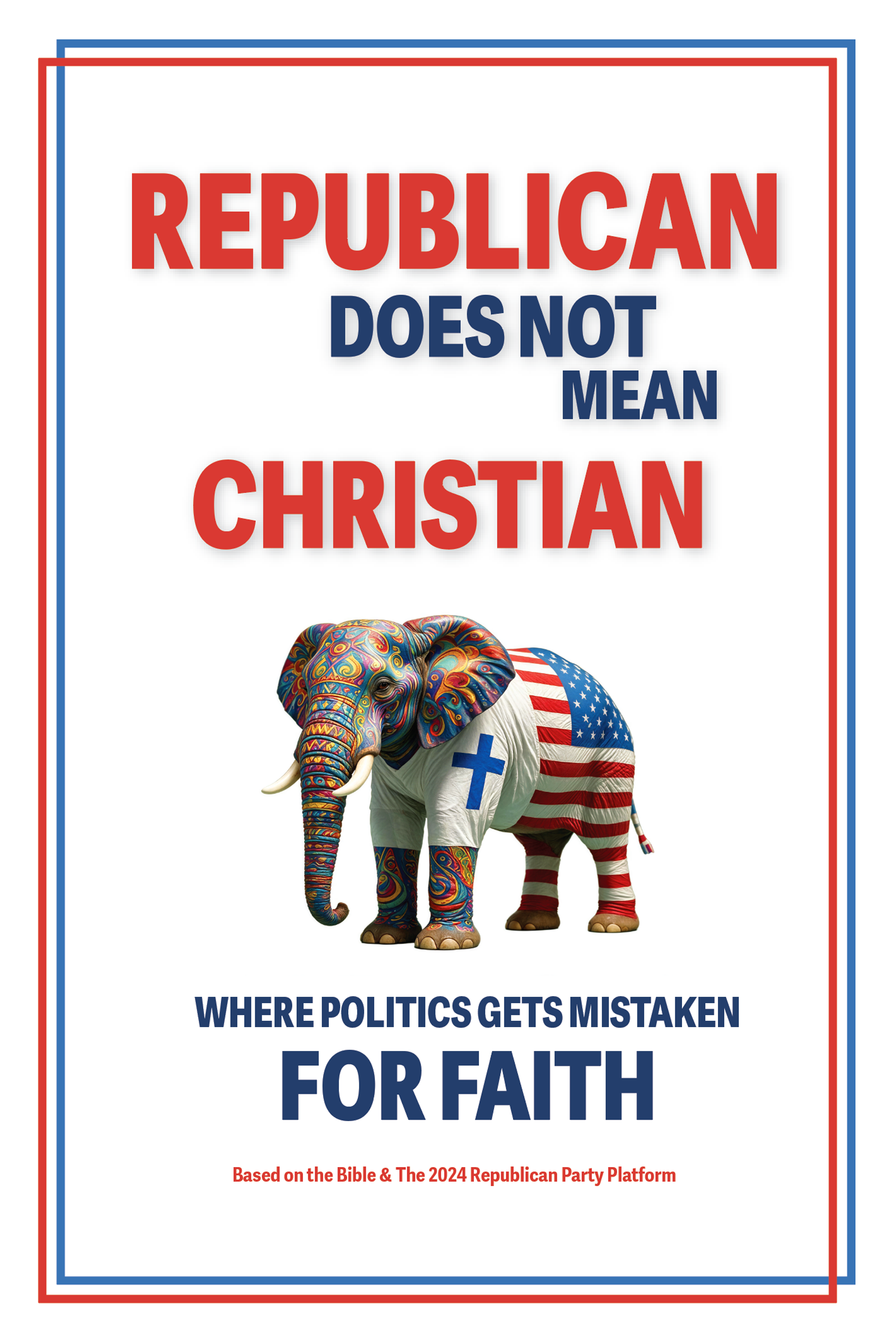
You are currently viewing this book

Click here to read the entire book one of this two-part series
Republican Does Not Mean Christian: Where Politics Gets Mistaken For Faith - Chapter 6
Based On The Bible & U.S. Republican Party Platform For 2024
Anchored In More Than Faith
Quick Links to Each Chapter
Christianity Is Very Interesting When You Take A Closer Look
__________
Throughout this book, we have used Scripture as the standard against which political positions are measured. That raises an important question that deserves an answer before we reach the end: Why should the Bible be the standard at all? If Christianity were simply another political philosophy, cultural tradition, or collection of moral opinions, there would be little reason to place its teachings above those of a political party. But Christianity makes a very different claim. It claims that its authority does not originate with a government, political movement, majority vote, or influential leader. It claims that its authority originates with God.
That distinction is especially important when discussing the Republican Party because there are areas where positions in its current platform correspond with the biblical framework we have been using. But agreement does not establish authority. Christianity is not true because Republicans agree with it, any more than a biblical principle would become false if Republicans someday abandoned it. If the Republican Party disappeared tomorrow, the historical claims of Christianity would remain exactly where they were. If a future Republican platform reversed every moral position it currently holds, the question of whether Jesus Christ lived, died, and rose from the dead would remain unchanged. Politics can agree with Christianity, disagree with Christianity, or misunderstand Christianity, but politics cannot determine whether Christianity is true.
Unlike a political platform or the words of an influencer, Christianity is not built merely on slogans, shifting trends, or emotional appeal. Nor does it present itself as requiring a blind leap without anything that can be examined. Christianity invites examination of claims rooted in history, testimony, prophecy, and events presented as having occurred in the real world. Scripture itself repeatedly points toward witnesses, fulfilled prophecy, public events, and testimony as reasons to believe. From the prophets who preceded Christ to the testimony surrounding His ministry, death, and resurrection, Christianity presents itself not merely as a philosophy about how people ought to live, but as an account of something God actually did in human history.
Christianity is often described as a “faith-based religion,” but that does not mean biblical faith requires belief without evidence. Biblical faith is trust placed in what is believed to be true. The Gospel of Luke begins with Luke explaining that he had carefully investigated the events about which he was writing so that his reader could have certainty concerning what he had been taught. John explains that the signs he recorded were written so that people might believe. Paul did not present the resurrection merely as a spiritual metaphor; in 1 Corinthians 15:3–8, Paul appealed to people who were identified as witnesses to the risen Christ, even noting that many were still alive when he wrote.
— Corinthians 15:1-11
— Cornithians 15: 12-19
The Christian story also does not begin with a modern political leader, religious celebrity, or recent movement announcing that he alone has discovered a new truth. It reaches backward through the Hebrew Scriptures and their prophets and then forward into the life of Jesus Christ, whom the New Testament presents as the fulfillment of that earlier story. Christians see passages such as Isaiah 53, Micah 5, Psalm 22, and others as part of a prophetic pattern culminating in Christ. The New Testament then presents His ministry publicly, His crucifixion under Roman authority, and His resurrection through the testimony of those who claimed to have encountered Him afterward. Whether a person ultimately accepts those claims is an enormous question, but Christianity does not hide the fact that its truth depends upon them.
That characteristic also provides an important point of comparison with later religious movements built around individuals claiming distinctive revelation or spiritual authority. Jim Jones and the Peoples Temple, Joseph Smith and the Latter-day Saint movement, Charles Taze Russell and the movement from which Jehovah’s Witnesses developed, Mary Baker Eddy and Christian Science, and L. Ron Hubbard and Scientology all appeared many centuries after Christianity began. Islam likewise arose centuries after Jesus and makes claims concerning Jesus, revelation, and God that differ substantially from Christianity. The point is not merely that these movements are single prophet centered and have founders or influential figures; Christianity had prophets, apostles, and teachers as well. (Examine each of these religious faiths in detail in “If God Exists, Which God Is Real?”) The more important question is whether a religious claim can be examined beyond the authority of the person presenting it—through earlier texts, historical setting, public proclamation, testimony, and other evidence capable of being investigated.
The tragedy of following human religious authority without adequately testing its claims can be seen vividly in the Peoples Temple, where more than 900 people died at Jonestown in 1978 after following Jim Jones to a horrific end. Christianity itself warns against blindly accepting someone merely because he claims spiritual authority. Scripture tells believers to test what they hear, warns repeatedly about false prophets, and even praises the Bereans in Acts 17 for examining the Scriptures to evaluate what Paul and Silas were teaching. That principle is important throughout this book as well. A politician, pastor, or priest, does not become a source of Christian truth because he calls himself Christian, and a political movement does not become Christianity because Christians support it. The claim must always be tested against something outside the person making it.
This brings us to an interesting way of thinking about the question of evidence. Consider the French mathematician, physicist, inventor, and philosopher Blaise Pascal, who lived from 1623 to 1662. Pascal is particularly interesting because he made important contributions to mathematics and the development of probability theory while also taking the Christian question extraordinarily seriously. His famous argument now known as Pascal’s Wager approached belief partly through the reasoning of risk and consequence. If you are a poker player, part of the logic may sound familiar: when certainty is unavailable, a rational person still has to make decisions while considering both uncertainty and the magnitude of what may ultimately be gained or lost.
Pascal reasoned that the question of God cannot simply be avoided because a person must live one way or the other. Living as though God exists or living as though He does not already places something at stake. If a person believes and God exists, the potential gain is infinite—eternal life—while the earthly costs associated with belief remain finite. If God does not exist, whatever temporal cost was incurred remains finite. Conversely, if a person rejects God and God exists, what is potentially lost is immeasurably greater. Pascal was not claiming that mathematics proves God’s existence, nor was he suggesting that a person can manufacture genuine Christian faith merely by calculating the safest bet. His argument was that uncertainty does not automatically make unbelief the rational default.
Pascal’s Wager therefore should not be treated as the evidence for Christianity. It is better understood as a reason not to dismiss the investigation. The wager asks us to recognize the extraordinary magnitude of the question and then consider whether the claims deserve serious examination. Once a person recognizes what may be at stake, the next logical question becomes considerably more interesting: Is there actually evidence that Christianity’s claims are true?
Pascal was working with the knowledge available to him in the seventeenth century, long before many later archaeological discoveries and developments in textual and historical scholarship. Yet the fundamental point remains useful. You do not have to possess absolute certainty before you begin examining evidence. You only have to recognize that the question may be important enough to investigate honestly. Christianity makes claims large enough that dismissing them without examination is itself a decision.
And that is what the remainder of this chapter is about. If Christianity is going to be the standard by which we measure anything—including our politics—then it deserves to be examined first on its own terms. So for the moment, set the Republican Party aside. Set politics aside. What follows does not depend upon whether a political platform is conservative or liberal. The question now is much more fundamental: Is there good reason to believe Christianity itself is true?
Examples of Prophecy Fulfilled
Centuries before Jesus’ birth, the Hebrew Scriptures foretold in extraordinary detail the events of His life, death, and resurrection.
- His birthplace — “But you, Bethlehem Ephrathah… from you shall come forth for me one who is to be ruler in Israel” (Micah 5:2) — (written between 740 – 700 B.C.).
- His betrayal for 30 pieces of silver — “So they weighed out as my wages thirty pieces of silver” (Zechariah 11:12–13) — (written between 520 – 480 B.C.).
- His death by piercing — “They have pierced my hands and my feet” (Psalm 22:16) — (David’s reign is generally dated 1010–970 B.C.).
- The casting of lots for His clothing — “They divide my garments among them and cast lots for my clothing” (Psalm 22:18) — (David’s reign is generally dated 1010–970 B.C.).
- His silence before His accusers — “He was oppressed and afflicted, yet he did not open his mouth” (Isaiah 53:7) — (written between 740 – 680 B.C.).
- His burial among the rich — “He was assigned a grave with the wicked, and with the rich in his death” (Isaiah 53:9) — (written between 740 – 680 B.C.).
- And even His resurrection — “You will not abandon me to the grave, nor will you let your Holy One see decay” (Psalm 16:10)— (David’s reign is generally dated 1010–970 B.C.).
These prophecies were written hundreds of years before Jesus was born — and fulfilled as recorded in the New Testament. But two of the most extraordinary details are often overlooked:
- Not a bone of His body was broken.
Crucifixion victims were customarily finished off by breaking their legs with a heavy mallet to hasten death. Yet John 19:33–36 records that when soldiers came to Jesus, “they did not break His legs,” because He was already dead — fulfilling Psalm 34:20: “He keeps all his bones; not one of them is broken.” This was not a detail Jesus could control — it was divine orchestration, written a thousand years before crucifixion even existed. - Crucifixion itself had not yet been invented when it was prophesied.
Psalm 22, written by David around 1000 B.C., describes in vivid detail a form of execution — piercing of hands and feet, public humiliation, thirst, and the dividing of garments — that would not even exist for another 600 years. (Psalm 22:16-18— For dogs encompass me; a company of evildoers encircles me; they have pierced my hands and feet—I can count all my bones—they stare and gloat over me; they divide my garments among them, and for my clothing they cast lots.) The Persians introduced crucifixion around 500 B.C., and the Romans perfected it centuries later. The prophetic accuracy is staggering — a dead man could not arrange these details, and no impostor could fulfill them.
These are not coincidences; they are confirmations. They show that Jesus’ death was not an accident of history, but the fulfillment of a divine plan written long before Bethlehem, Calvary, or Rome ever existed.
The Transformation of the Disciples
The resurrection stands as one of the most documented and most world-changing events in history. The disciples’ transformation from terrified fugitives hiding in a room to fearless martyrs is perhaps the most convincing evidence of all.
When Jesus was arrested, His closest followers fled. Peter denied Him three times. They hid, thinking the movement was over and that they had been deceived. But three days later, they encountered something that changed their hearts completely —the risen Christ — not as a ghost or a vision, but in bodily form. They touched Him, ate with Him, and spoke with Him. Whether you believe it or not, that experience turned their despair into an unshakable conviction that cannot be denied. And each one paid for that conviction with their lives:
- Peter — Crucified upside down in Rome under Nero, declaring himself unworthy to die like his Lord.
- Andrew — Crucified on an X-shaped cross in, Patras Greece, preaching forgiveness to his executioners.
- James (son of Zebedee) — Executed by sword under Herod Agrippa (Acts 12:2).
- John — Exiled to Patmos; the only apostle to die a natural death after a lifetime of persecution. Died a natural death in Ephesus.
- Philip — Executed in Hierapolis (modern Turkey) after converting the proconsul’s wife.
- Bartholomew (Nathaniel) — Martyred in Armenia, reportedly flayed alive or beheaded for his faith.
- Thomas — Speared to death near Chennai, India after founding early churches there.
- Matthew (Levi) — Killed in Ethiopia or Persia while preaching the gospel.
- James (son of Alphaeus) — Stoned or clubbed to death in Jerusalem.
- Thaddaeus (Jude) — Martyred in Persia.
- Simon the Zealot — Crucified or sawn in half for his faith in Persia or Syria.
- Matthias — Stoned and beheaded in Jerusalem or Ethiopia.
- Paul — Once a zealous servant of the Jewish authorities, Paul sought to persecute Christians and was even present at Stephen’s stoning. After his dramatic conversion, he became one of Christianity’s most influential apostles, writing nearly two-thirds of the New Testament. He was eventually beheaded in Rome under Emperor Nero after enduring years of imprisonment and persecution.
Not one of them renounced his testimony. They had to have seen the risen Lord — they chose to die rather than deny it, even though they could have run. As once said “Liars make poor martyrs.”— People may die for what they believe to be true, but these men died for what they knew was true.
Consensus: Nearly all early sources (both canonical and post-canonical) attest that the apostles died violent deaths, maintaining their testimony of the resurrection — a core apologetic argument for Christianity’s historical truth.
Jesus’ Cry on the Cross — Not Doubt, But Declaration
One of the most misunderstood moments in Scripture occurs when Jesus cried out from the cross, “My God, My God, why have You forsaken Me?” (Matthew 27:46). Many interpret this as a moment of despair, as if Jesus were questioning His Father and what he had taken on. But this is not a cry of abandonment — it is a proclamation of identity and fulfillment.
Jesus was quoting Psalm 22, a prophetic psalm written 1,000 years earlier that describes crucifixion in detail long before the practice existed. By speaking its opening line, Jesus directed the crowd — especially the Jewish leaders who knew the Scriptures — to the full message of that psalm. It begins with anguish but ends in triumph:
Psalm 22 (ESV)
My God, my God, why have you forsaken me?
Why are you so far from saving me, from the words of my groaning?
2 O my God, I cry by day, but you do not answer,
and by night, but I find no rest.
3 Yet you are holy,
zenthroned on the praises1 of Israel.
4 In you our fathers trusted;
they trusted, and you delivered them.
5 To you they cried and were rescued;
in you they trusted and were not put to shame.
6 But I am a worm and not a man,
scorned by mankind and despised by the people.
7 All who see me mock me;
they make mouths at me; they wag their heads;
8 “He trusts in the LORD; let him deliver him;
let him rescue him, for he delights in him!”
9 Yet you are he who took me from the womb;
you made me trust you at my mother’s breasts.
10 On you was I cast from my birth,
and from my mother’s womb you have been my God.
11 Be not far from me,
for trouble is near,
and there is none to help.
12 Many bulls encompass me;
strong bulls of Bashan surround me;
13 they open wide their mouths at me,
like a ravening and roaring lion.
14 I am poured out like water,
and all my bones are out of joint;
my heart is like wax;
it is melted within my breast;
15 my strength is dried up like a potsherd,
and my tongue sticks to my jaws;
you lay me in the dust of death.
16 For dogs encompass me;
a company of evildoers encircles me;
they have pierced my hands and feet—
17 I can count all my bones—
they stare and gloat over me;
18 they divide my garments among them,
and for my clothing they cast lots.
19 But you, O LORD, do not be far off!
O you my help, come quickly to my aid!
20 Deliver my soul from the sword,
my precious life from the power of the dog!
21 Save me from the mouth of the lion!
You have rescued me from the horns of the wild oxen!
22 I will tell of your name to my brothers;
in the midst of the congregation I will praise you:
23 You who jfear the LORD, praise him!
All you offspring of Jacob, glorify him,
and stand in awe of him, all you offspring of Israel!
24 For he has not despised or abhorred
the affliction of the afflicted,
and he has not hidden his face from him,
but has heard, when he cried to him.
25 From you comes my praise in the great congregation;
my vows I will perform before those who fear him.
26 The afflicted shall eat and be satisfied;
those who seek him shall praise the LORD!
May your hearts tlive forever!
27 All the ends of the earth shall remember
and turn to the LORD,
and all the families of the nations
shall worship before you.
28 For kingship belongs to the LORD,
and he rules over the nations.
29 All the prosperous of the earth eat and worship;
before him shall bow all who go down to the dust,
even the one who could not keep himself alive.
30 Posterity shall serve him;
it shall be told of the Lord to the coming generation;
31 they shall come and proclaim his righteousness to a people yet unborn,
that he has done it.
(Written c. 1000 B.C.)
- “They shall proclaim His righteousness to a people yet unborn — that He has done it.” (Psalm 22:31) Those final words, “He has done it,” echo Jesus’ own final declaration on the cross: “It is finished.” (John 19:30) He was not doubting God; He was declaring victory.
A Faith Proven by History
No other major religion is so deeply rooted in time, place, prophecy, and evidence.
- Over 40 authors wrote the Bible across 1,500 years with a single, unified message, ending in the New Testament.
- Over 25,000 ancient manuscripts confirm its textual integrity — far more than any other ancient document.
- Archaeological discoveries continually affirm its accuracy — from the Pool of Bethesda (John 5) to the ossuary of Caiaphas, the high priest who condemned Jesus.
- Secular historians like Tacitus, Josephus, and Pliny the Younger record the existence of Jesus, His crucifixion under Pontius Pilate, and His followers’ unwavering devotion.
- +500 eyewitnesses saw the risen Christ (1 Corinthians 15:6).
In contrast, other religions trace back to one person’s private vision or philosophy.
Islam centers on Muhammad’s personal revelations.
- Buddhism on the insights of Siddhartha Gautama.
- Hinduism on a collection of mythic traditions.
- Mormonism on Joseph Smith’s claimed golden plates.
- Christianity alone stands on public revelation, fulfilled prophecy, and historical fact. It is not man reaching for God — it is God reaching for man.
The Unshakable Truth
Christianity is not true because it works; it works because it is true. The gospel is not an idea but an event — the death and resurrection of Jesus Christ, witnessed in history and confirmed in hearts for two thousand years.
The disciples didn’t invent a religion; they bore witness to a reality that changed everything. The resurrection was not symbolic, spiritual, or metaphorical — it was physical, historical, and eternal — and that is what sets Christianity apart from every man-made faith: others offer rules, rituals, or enlightenment. Jesus offers redemption. Others point to moral systems; Jesus points to Himself — the living God who entered history, died for sin, and rose again.
Christianity alone stands because Christ alone lives.
Biblical Prophecies Fulfilled in Jesus Christ
| Prophecy | Old Testament Reference | New Testament Fulfillment | Notes / Significance |
| Birth in Bethlehem | Micah 5:2 | Matthew 2:1; Luke 2:4–7 | Written c. 700 B.C. — specifies the small town of Bethlehem as Messiah’s birthplace. |
| Betrayal for 30 pieces of silver | Zechariah 11:12–13 | Matthew 26:14–15; 27:3–10 | Foretold the price of betrayal and the silver’s use for a potter’s field. |
| Crucifixion (pierced hands and feet) | Psalm 22:16 | John 19:18, 20:25 | Describes crucifixion 600+ years before it was invented. |
| Soldiers casting lots for clothing | Psalm 22:18 | John 19:23–24 | Fulfilled literally at the foot of the cross. |
| Silent before accusers | Isaiah 53:7 | Matthew 27:12–14 | Jesus’ silence before Pilate and the Sanhedrin. |
| Buried with the rich | Isaiah 53:9 | Matthew 27:57–60 | Fulfilled by Joseph of Arimathea’s tomb. |
| Resurrection / not seeing decay | Psalm 16:10 | Acts 2:31; Luke 24 | Predicts Messiah’s resurrection. |
| None of His bones broken | Psalm 34:20; Exodus 12:46 | John 19:33–36 | Despite crucifixion norms, His legs were not broken, fulfilling both the Passover Lamb and Davidic prophecy. |
| Pierced side | Zechariah 12:10 | John 19:34, 37 | Spear thrust recorded by eyewitness John. |
Important Note: Crucifixion was unknown in David’s time (Psalm 22, c. 1000 B.C.), yet he describes it with remarkable anatomical accuracy — “they pierced my hands and my feet,” “I am poured out like water,” “my bones are out of joint.” The Persians introduced crucifixion around 500 B.C., long after the psalm was written.
Early Non-Christian Historical Sources Confirming Jesus and Christianity
| Source | Date | Quotation / Summary | Reference |
| Tacitus (Roman historian) | c. A.D. 115 | “Christus… suffered the extreme penalty during the reign of Tiberius at the hands of… Pontius Pilate.” | Annals XV.44 |
| Josephus (Jewish historian) | c. A.D. 93 | Mentions Jesus as “a wise man… a doer of wonderful works… He was the Christ… he appeared to them alive again the third day.” | Antiquities of the Jews XVIII.3.3 |
| Pliny the Younger (Roman governor) | c. A.D. 112 | Writes to Emperor Trajan about Christians “who sing hymns to Christ as to a god.” | Epistles X.96 |
| Lucian of Samosata (Greek satirist) | c. A.D. 170 | Mocks Christians for worshiping “the crucified sage” and their belief in immortality. | The Passing of Peregrinus 11–13 |
| Thallus (Samaritan historian) | c. A.D. 52 (lost work, quoted by Julius Africanus) | Attempted to explain away the darkness at Jesus’ crucifixion as an eclipse. | Quoted in Africanus, Chronography (A.D. 221) |
Note: All of these secular historians — none of them Christian — corroborate key facts: Jesus lived, was executed under Pilate, His followers worshiped Him as divine, and they persisted despite persecution.
Archaeological and Manuscript Evidence
- Manuscript Evidence:
- Over 25,000 ancient New Testament manuscripts, including early papyri such as P52 (John fragment, c. A.D. 125) and Codex Sinaiticus (A.D. 330–360).
- Compared to other ancient works (e.g., Homer’s Iliad has ~650 manuscripts), the Bible’s transmission shows reliability.
- Archaeological Corroboration:
- The Pool of Bethesda (John 5) — excavated 19th century, matching John’s description (five porticoes).
- Pilate Stone — discovered at Caesarea Maritima (1961), confirming Pontius Pilate’s historical existence.
- Caiaphas Ossuary — found 1990, inscribed with the name of the high priest involved in Jesus’ trial.
- Nazareth Inscription — a Roman decree against grave robbing from the early 1st century, connected to early Christian claims of resurrection (the inscription is authentic, but its direct connection to Christianity is suggestive, not conclusive).
Theological and Historical Scholarship Supporting Christianity’s Uniqueness
- F.F. Bruce, The New Testament Documents: Are They Reliable? (Eerdmans, 1981).
- Lee Strobel, The Case for Christ (Zondervan, 1998) — journalistic investigation into historical and scientific evidence for Jesus.
- Josh McDowell, Evidence That Demands a Verdict (Thomas Nelson, 2017).
- Gary Habermas & Michael Licona, The Case for the Resurrection of Jesus (Kregel, 2004) — academic-level historical defense of the resurrection.
- N.T. Wright, The Resurrection of the Son of God (Fortress Press, 2003) — scholarly treatment of the resurrection as a historical event.
Christianity stands alone in its evidentiary foundation:
- Prophetic Evidence — Hundreds of verifiable Old Testament prophecies fulfilled in Christ (“Hundreds” is common apologetic language but debated numerically).
- Eyewitness Evidence — Disciples transformed and martyred for a truth they saw firsthand.
- Historical Evidence — Confirmed by Jewish, Roman, and secular historians.
- Archaeological Evidence — Tangible corroboration of biblical people, places, and events.
- Textual Evidence — Thousands of consistent manuscripts preserving the record with unmatched accuracy.
Christianity alone is a faith both believed by the heart and backed by history. All others were created by man for man’s purpose.
Sources: Specific text assignment for each footnote in printed edition
-
Republican National Committee, The 2024 Republican Platform: Make America Great Again! 43rd Republican National Convention, 2024.
All sources identified as footnotes in printed text
Additional Matter Of Fact Books
Click image to find out more.

Matter Of Fact Books
Our books are priced to sell and change lives.