
God, Politics & Party
A Two-Part Series for Those Who Struggle With Where Politics Ends and Faith Begins
“Every generation faces its own battle for truth, and ours is no different. The danger today is not persecution from without, but deception from within. The most effective lies are not shouted in rebellion but whispered in the language of love, progress, and compassion. They sound noble, they feel kind, and they appear moral — yet they slowly replace obedience with emotion, and truth with tolerance.” — C. J. Bartels
Matter of Fact Books is making both books available to read free of charge for a limited time, in the hope that, if you identify as a Christian, you will truly understand what you have chosen to believe.
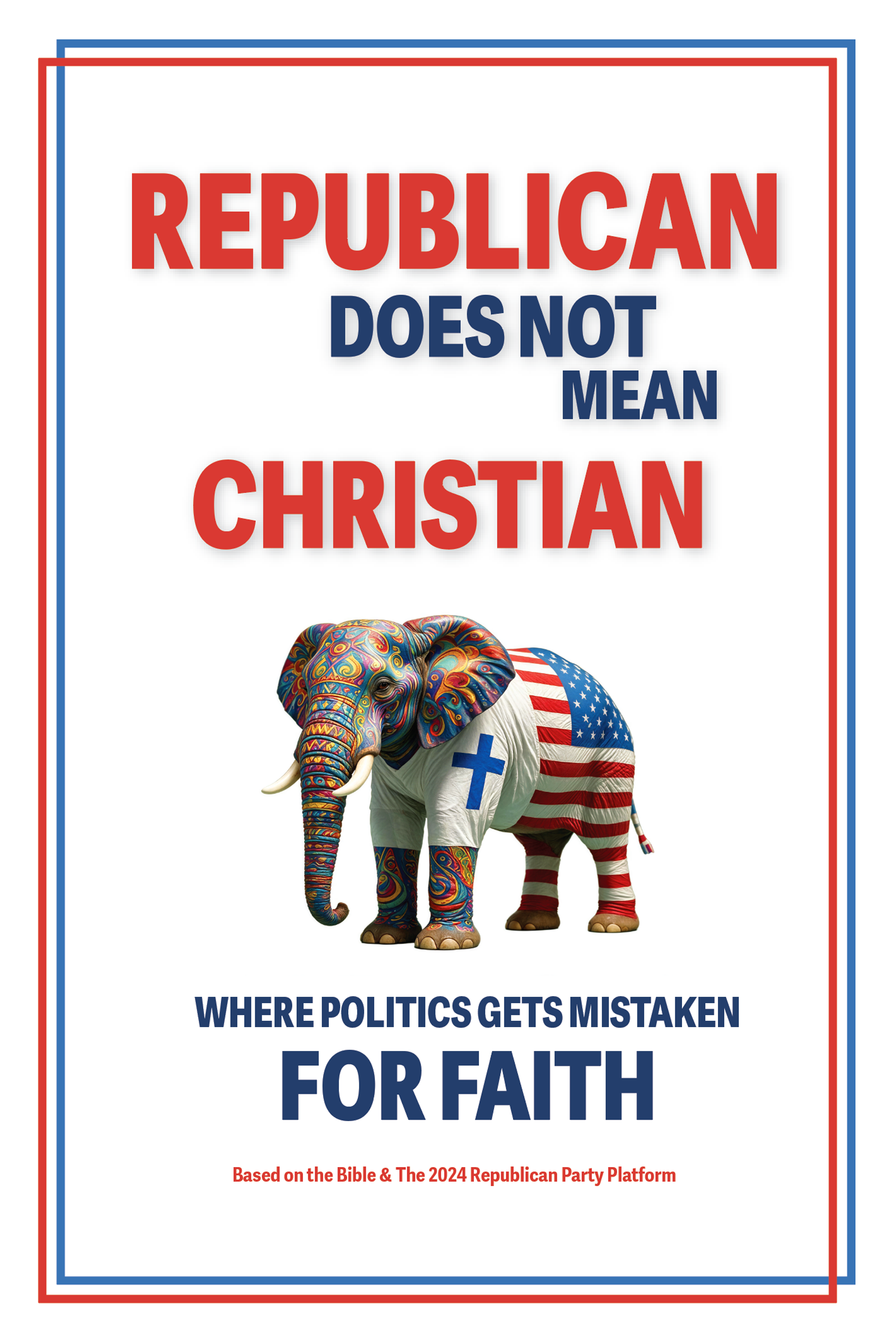
You are currently viewing this book

Click here to read the entire book one of this two-part series
Republican Does Not Mean Christian: Where Politics Gets Mistaken For Faith - Chapter 5
Based On The Bible & U.S. Republican Party Platform For 2024
The Art Of Deception
Quick Links to Each Chapter
__________
Jesus called the devil “the father of lies” in John 8:44.
They answered him, “We are offspring of Abraham and have never been enslaved to anyone. How is it that you say, ‘You will become free’?”
Jesus answered them, “Truly, truly, I say to you, everyone who practices sin is a slave to sin. The slave does not remain in the house forever; the son remains forever. So if the Son sets you free, you will be free indeed. I know that you are offspring of Abraham; yet you seek to kill me because my word finds no place in you. I speak of what I have seen with my Father, and you do what you have heard from your father.”
They answered him, “Abraham is our father.”
Jesus said to them, “If you were Abraham’s children, you would be doing the works Abraham did, but now you seek to kill me, a man who has told you the truth that I heard from God. This is not what Abraham did. You are doing the works your father did.”
They said to him, “We were not born of sexual immorality. We have one Father—even God.”
Jesus said to them, “If God were your Father, you would love me, for I came from God and I am here. I came not of my own accord, but he sent me. Why do you not understand what I say? It is because you cannot bear to hear my word. You are of your father the devil, and your will is to do your father’s desires. He was a murderer from the beginning, and does not stand in the truth, because there is no truth in him. When he lies, he speaks out of his own character, for he is a liar and the father of lies. But because I tell the truth, you do not believe me. Which one of you convicts me of sin? If I tell the truth, why do you not believe me? Whoever is of God hears the words of God. The reason why you do not hear them is that you are not of God.”
—John 8:31-47
Therefore take up the whole armor of God, that you may be able to withstand in the evil day, and having done all, to stand firm. Stand therefore, having fastened on the belt of truth, and having put on the breastplate of righteousness, and, as shoes for your feet, having put on the readiness given by the gospel of peace.
In all circumstances take up the shield of faith, with which you can extinguish all the flaming darts of the evil one; and take the helmet of salvation, and the sword of the Spirit, which is the word of God, praying at all times in the Spirit, with all prayer and supplication.
To that end, keep alert with all perseverance, making supplication for all the saints, and also for me, that words may be given to me in opening my mouth boldly to proclaim the mystery of the gospel, for which I am an ambassador in chains, that I may declare it boldly, as I ought to speak.
—Ephesians 6:10-20
But God, being rich in mercy, because of the great love with which he loved us, even when we were dead in our trespasses, made us alive together with Christ—by grace you have been saved—and raised us up with him and seated us with him in the heavenly places in Christ Jesus, so that in the coming ages he might show the immeasurable riches of his grace in kindness toward us in Christ Jesus. For by grace you have been saved through faith. And this is not your own doing; it is the gift of God, not a result of works, so that no one may boast. For we are his workmanship, created in Christ Jesus for good works, which God prepared beforehand, that we should walk in them.
—Ephesians 2:1-10
Likewise, you who are younger, be subject to the elders. Clothe yourselves, all of you, with humility toward one another, for “God opposes the proud but gives grace to the humble.”
Humble yourselves, therefore, under the mighty hand of God so that at the proper time he may exalt you, casting all your anxieties on him, because he cares for you. Be sober-minded; be watchful. Your adversary the devil prowls around like a roaring lion, seeking someone to devour. Resist him, firm in your faith, knowing that the same kinds of suffering are being experienced by your brotherhood throughout the world.
And after you have suffered a little while, the God of all grace, who has called you to his eternal glory in Christ, will himself restore, confirm, strengthen, and establish you. To him be the dominion forever and ever. Amen.
—1 Peter 5:1:11
That distinction is especially important when examining political allegiance. A Christian is unlikely to be persuaded by a political movement that openly announces, “Reject God and follow us instead.” The more believable temptation is a movement that agrees with Christians on several important issues, speaks favorably about their beliefs, defends some of their freedoms, and consequently earns their trust. Even a statement as true as “Jesus is love” can become misleading if it is used as though it were the whole of what Christianity teaches. Jesus is love, but He also calls people to repentance, speaks about sin, commands obedience, warns of judgment, and identifies Himself with truth. None of those truths cancels His love; together they help us understand what His love means. The same caution applies to political movements. Genuine agreement is not inherently deceptive, and Christians should acknowledge it when it exists. The danger begins when legitimate agreement slowly becomes unquestioned confidence, unquestioned confidence becomes allegiance, and allegiance makes it increasingly difficult to judge the movement by the same biblical standard that caused the Christian to support it in the first place.
That possibility deserves particular attention when considering the Republican Party because our examination of its written platform found substantial areas of agreement with the biblical framework used throughout this book. The platform speaks positively about life and family, defends religious liberty, opposes policies that redefine biological sex, supports parental authority, and takes other positions that many Christians can support for specifically biblical reasons. On many additional questions involving economics, immigration, energy, education, healthcare, trade, national defense, and the proper size of government, we found principles worth considering but not biblical commands establishing one mandatory political policy. Abortion and IVF raised more serious moral questions, but even there careful examination required us to distinguish what the platform actually says from conclusions we might be tempted to place into it.
Those findings create a spiritual danger that may initially seem surprising. A political party does not have to be consistently opposed to biblical teaching to become too important in the life of a Christian. In some ways, agreement on deeply important issues can create a particularly subtle test of allegiance because agreement earns trust. Once trust is established, Christians may gradually stop asking the question with which this book began: What does God actually say? The temptation can then become, “Because this party is right about these important things, perhaps I can trust it about the rest.” Because it defends convictions I believe come from Scripture, perhaps defending the party becomes part of defending Christianity. Because its political opponents reject things I consider biblically clear, perhaps criticism of the Republican Party begins to feel like criticism of the Christian cause. None of those conclusions has to be consciously adopted. They can develop gradually until the political party that was once being measured against Scripture begins influencing how Scripture itself is applied.
That is an important distinction because the deception being discussed here does not require the Republican Party to be intentionally deceiving Christians. Political parties naturally attempt to persuade voters, build coalitions, win elections, and retain support. The spiritual responsibility belongs to the Christian to determine what level of allegiance any political institution is permitted to receive. Deception does not have to replace truth completely to become effective. It may only need to move the source of authority a little at a time until the believer no longer notices that something other than Scripture has begun influencing the measurement.
How Spiritual Deception Operates
Scripture repeatedly warns believers to test what they hear. Jesus warned that false teachers could deceive even the elect in Matthew 24:24.
For then there will be great tribulation, such as has not been from the beginning of the world until now, no, and never will be. And if those days had not been cut short, no human being would be saved. But for the sake of the elect those days will be cut short.
Then if anyone says to you, ‘Look, here is the Christ!’ or ‘There he is!’ do not believe it. For false christs and false prophets will arise and perform great signs and wonders, so as to lead astray, if possible, even the elect. See, I have told you beforehand.
So, if they say to you, ‘Look, he is in the wilderness,’ do not go out. If they say, ‘Look, he is in the inner rooms,’ do not believe it. For as the lightning comes from the east and shines as far as the west, so will be the coming of the Son of Man. Wherever the corpse is, there the vultures will gather.
—Matthew 24:15-28
Indeed, I consider that I am not in the least inferior to these super-apostles. Even if I am unskilled in speaking, I am not so in knowledge; indeed, in every way we have made this plain to you in all things.
Or did I commit a sin in humbling myself so that you might be exalted, because I preached God’s gospel to you free of charge? I robbed other churches by accepting support from them in order to serve you. And when I was with you and was in need, I did not burden anyone, for the brothers who came from Macedonia supplied my need. So I refrained and will refrain from burdening you in any way. As the truth of Christ is in me, this boasting of mine will not be silenced in the regions of Achaia. And why? Because I do not love you? God knows I do!
And what I am doing I will continue to do, in order to undermine the claim of those who would like to claim that in their boasted mission they work on the same terms as we do. For such men are false apostles, deceitful workmen, disguising themselves as apostles of Christ. And no wonder, for even Satan disguises himself as an angel of light. So it is no surprise if his servants, also, disguise themselves as servants of righteousness. Their end will correspond to their deeds.
—2 Corinthians 11:1-15
By this you know the Spirit of God: every spirit that confesses that Jesus Christ has come in the flesh is from God, and every spirit that does not confess Jesus is not from God. This is the spirit of the antichrist, which you heard was coming and now is in the world already.
Little children, you are from God and have overcome them, for he who is in you is greater than he who is in the world. They are from the world; therefore they speak from the world, and the world listens to them.
We are from God. Whoever knows God listens to us; whoever is not from God does not listen to us. By this we know the Spirit of truth and the spirit of error.
—1 John 4:1-6
Subtraction
One of the oldest methods of deception is subtraction. The serpent’s question to Eve—“Did God actually say?”—did not begin with a complete rejection of God. It began by questioning what God had actually commanded. But Scripture warns about the opposite error as well. Deuteronomy 4:2 says, “You shall not add to the word that I command you, nor take from it.” Proverbs 30:5–6 similarly warns against adding to God’s words. Biblical authority can therefore be compromised in either direction. We can remove something God has commanded, or we can attach God’s authority to something He never commanded.
This second danger becomes particularly important in Republican politics because many conservative political positions are expressed through moral concepts Christians already recognize: responsibility, freedom, family, order, justice, work, national security, religious liberty, protection of life, and parental authority. Some political positions associated with those ideas may follow reasonably from biblical principles. But that does not make every policy proposed in their name a biblical command. Scripture commands justice, but that does not automatically make one particular criminal-justice policy “God’s policy.” Scripture recognizes governing authority, but it does not establish America’s proper annual immigration quota. Scripture commands stewardship of creation, but it does not specify how much American energy should come from oil, natural gas, nuclear power, wind, or solar power. Scripture teaches responsibility, work, generosity, family obligation, and care for the poor, but it does not establish the correct marginal tax rate. Scripture recognizes government’s authority to punish wrongdoing and protect the innocent, but it does not tell Congress precisely how large the military budget should be.
A Christian can have strong opinions about every one of those questions. He may even believe biblical principles make one answer considerably wiser than another. But the danger can move in either direction. Christians can begin calling their political judgments “biblical” merely because those judgments are conservative or Republican. Others can become so disillusioned by the words or conduct of a politician who identifies with Christians, or is strongly supported by them, that they begin judging Christianity itself by that politician rather than by Christ and Scripture. In both cases, a political figure or movement has been given an authority it should never possess.
Something subtle has happened when politics begins determining what we believe Christianity is. Instead of allowing Scripture to provide the boundaries within which political wisdom operates, we begin allowing political personalities, political loyalties, or political disappointments to shape our understanding of Scripture and the faith it teaches. That is not necessarily the same as deliberately rejecting Scripture, but it can ultimately interfere with Scripture’s authority by making it difficult to distinguish God’s commands from our political application of them—or, in the opposite direction, to distinguish Christianity itself from the words and actions of people who claim to represent it.
Selective Moral Vision
Deception can also operate through selective moral vision. Jesus described this human tendency in Matthew 7:3–5 when He asked why someone notices the speck in another person’s eye while ignoring the log in his own.
—Matthew 7:1-5
Scripture does not provide separate moral standards for political allies and political enemies. Proverbs 20:23 says that “unequal weights are an abomination to the Lord.” The immediate context concerns dishonest measurement, but the image illustrates a principle Christians should recognize: the scale cannot change depending upon what is being weighed. If truthfulness matters when evaluating one politician, truthfulness remains morally relevant when evaluating another. If sexual morality is a Christian principle, changing the political usefulness of the person involved cannot change the principle. The same is true of arrogance, greed, vengeance, hatred, partiality, dishonesty, and other behavior Scripture addresses. Political circumstances may affect how heavily particular conduct weighs in a political decision, but they cannot change whether the conduct itself is right or wrong.
Confusing The Defender With Truth
There is another subtle danger when a political party defends things Christians believe are good: confusing the defender of a truth with the source of that truth. The Republican Party may defend religious liberty, but it did not create religious truth. It may seek to protect unborn life, but it did not create human life. It may defend marriage and family, but it did not establish either one. It may defend parental rights, but it did not create the relationship between parent and child. It may defend the ability to read Scripture and pray publicly, but it did not give Scripture its authority. Those distinctions matter because the defender can change while the truth being defended does not. If Christians become so grateful to a political movement for defending biblical convictions that they begin treating the movement itself as possessing biblical authority, the relationship has quietly reversed. Instead of judging the political movement by Christianity, Christianity begins to be understood through the political movement, even though no one ever consciously announced that Christ had been replaced.
When Patriotism Becomes Something More
Patriotism itself is not condemned by Scripture. There is nothing inherently wrong with loving one’s country, appreciating its history, honoring those who sacrificed for it, wanting it to prosper, or believing that government has particular responsibilities toward its own citizens. Paul expressed deep affection for his own people in Romans 9 and 13, and Scripture recognizes nations, rulers, peoples, and legitimate civil authority. A Christian does not have to dislike his country in order to prove his allegiance to God.
For rulers are not a terror to good conduct, but to bad. Would you have no fear of the one who is in authority? Then do what is good, and you will receive his approval, for he is God’s servant for your good. But if you do wrong, be afraid, for he does not bear the sword in vain. For he is the servant of God, an avenger who carries out God’s wrath on the wrongdoer.
Therefore one must be in subjection, not only to avoid God’s wrath but also for the sake of conscience. For because of this you also pay taxes, for the authorities are ministers of God, attending to this very thing.
Pay to all what is owed to them: taxes to whom taxes are owed, revenue to whom revenue is owed, respect to whom respect is owed, honor to whom honor is owed.
—Romans 13: 1-7
Their end is destruction, their god is their belly, and they glory in their shame, with minds set on earthly things. But our citizenship is in heaven, and from it we await a Savior, the Lord Jesus Christ, who will transform our lowly body to be like his glorious body, by the power that enables him even to subject all things to himself.
—Philippians 3:17-21
Jesus told Pilate in John 18:36, “My kingdom is not of this world.” Revelation presents the redeemed as people from every tribe, language, people, and nation gathered before God. The Christian can love America deeply while recognizing that America can never occupy the place belonging to the kingdom of God.
This distinction matters when considering the Republican emphasis on putting America first. As established earlier, prioritizing American interests is not itself a biblical contradiction. Governments possess responsibilities toward the people they govern, and Scripture does not prescribe a foreign-policy formula requiring American officials to place the political or economic interests of another nation ahead of those of their own citizens. A Christian may therefore support an America First approach to questions of trade, defense, immigration, energy, or foreign policy without violating Scripture merely because those policies begin with American interests. The official Republican platform itself repeatedly frames its policies around American workers, citizens, security, energy production, manufacturing, and national interests.
The spiritual question begins when we ask what “first” means in the heart of the Christian. America can come before another country’s political interests without coming before God. National interest can influence foreign policy without determining Christian morality. A Christian can favor American prosperity without believing Americans possess greater value before God. A government can protect its citizens without Christians becoming indifferent to the humanity of people outside its borders. The boundary is crossed when national interest begins determining what the Christian considers morally right. If something becomes acceptable merely because it benefits America, if injustice becomes tolerable because Americans gain from it, or if another person’s God-given dignity matters less because he belongs to another nation, then patriotism has begun functioning as something more than patriotism. It has become a moral authority competing with the authority of God.
This is why Christians should be particularly careful when Christian language and political language naturally overlap. Words such as God, country, freedom, faith, family, life, and truth can appear comfortably beside one another, and many of those associations can reflect sincere convictions. But God and country do not occupy parallel positions in Christianity. One is Creator and the other creation. One is eternal and the other temporary. One commands ultimate allegiance while the other deserves allegiance only within the moral boundaries established by the first. Loving America is not idolatry, and supporting an America First political policy is not equivalent to placing America before God. The Christian must simply remember which “first” is political and which “first” is eternal.
How the Drift Happens
Spiritual drift rarely occurs in one dramatic moment. It usually begins quietly and may even begin with something good. For a Republican Christian, the starting point may be a genuine biblical conviction. He becomes concerned about abortion and finds Republicans taking a position intended to protect unborn life. He becomes concerned about gender ideology and finds the Republican platform resisting policies that erase the biological distinction between male and female. He worries about religious liberty and sees Republican language defending the ability of Americans to live publicly according to their religious convictions. He believes family and parental responsibility matter and finds those subjects affirmed. Those positions appear in various forms in the official platform, which is precisely why the possibility of genuine political agreement should not be dismissed.
There is nothing inherently wrong with reaching political conclusions from those observations. They may provide reasons for supporting particular Republican policies or candidates. A Christian does not have to pretend political differences are meaningless simply because politics can become spiritually dangerous. Political decisions can affect human life, family, freedom, justice, national security, economic conditions, and the ability to practice one’s faith. The warning here is not against political conviction. It is against allowing political conviction to become a substitute for the continuing work of biblical judgment.
The drift begins when agreement becomes identification. At first the Christian says, “I support Republicans because I believe they are right on these issues.” Eventually the thought can quietly become, “Republicans are right because they are the party that stands for Christian values.” The words sound similar, but the order of authority has reversed. The party that was once being measured has begun influencing the measurement. After that, criticism becomes increasingly uncomfortable. When someone identifies a legitimate moral problem involving Republicans, the first instinct may no longer be to examine the criticism but to identify who made it. Is the source politically hostile? Is the speaker biased? Is the story intended to damage a Republican candidate? Those questions can sometimes reveal genuine problems with a claim, but none answers the most important question: Is what was said true?
The same shift can occur around individual political leaders. A leader may become important because he advances policies Christians sincerely believe are good. Gratitude for those policies can turn into loyalty to the person, loyalty can become defensiveness, and defensiveness can make legitimate moral criticism feel like political betrayal. Eventually a Christian may discover himself explaining behavior he would have condemned immediately had the identical behavior come from a political opponent. No doctrine had to change and no Bible verse had to be removed. The drift occurred through unequal application. The Christian still believes lying is wrong but becomes more interested in lies told by political opponents. He still believes character matters but becomes reluctant to acknowledge moral failures among political allies. He still believes every person bears God’s image but becomes increasingly comfortable speaking about political opponents with contempt. He still believes Scripture is the final authority but begins instinctively defending the political side before asking whether it needs correction.
This is what makes political drift particularly difficult to recognize. The person experiencing it may become more publicly identified as Christian, not less. He may speak more frequently about Christian values, religious liberty, the Bible, family, and God while simultaneously becoming less willing to allow those same biblical standards to judge his political allies. The Christian vocabulary can remain completely intact while the measuring line gradually moves.
Truth Must Matter Even When It Hurts Your Side
Modern Americans live inside political information systems designed to compete intensely for attention. Cable news, podcasts, talk radio, social media, political advertising, fundraising emails, campaign speeches, online personalities, and partisan websites constantly present claims intended to persuade audiences. Much of what reaches people is selected or framed because someone believes it will make them angry, afraid, hopeful, outraged, enthusiastic, or eager to share it. Christians therefore have an additional reason to slow down before accepting or repeating political claims.
The Christian’s responsibility is not to assume that one political side lies while another always tells the truth. It is to test claims. Proverbs 14:15 says, “The simple believes everything, but the prudent gives thought to his steps.” Proverbs 18:17 reminds us that the first version of a dispute can appear correct until it is examined. Exodus 23:1 warns, “You shall not spread a false report.” These principles create an uncomfortable responsibility in an age when sharing an accusation requires only seconds. Christians should care whether something is true before repeating it even when the story damages a political opponent, and perhaps especially then, because that is when we may be most inclined to want the story to be true.
This principle also applies to what we call a Republican position. A statement by a Republican politician does not automatically establish what the Republican Party officially believes. A comment made during an interview, something posted on social media, a proposal by a senator, an opinion expressed by a conservative commentator, or something shouted by a person at a rally cannot simply be inserted into the party platform. When this book claims to examine an official Republican Party position, the party must be judged by what it actually adopted in its official platform. This discipline protects Republicans from accusations based on things the party never adopted, but it also prevents us from escaping positions the party actually has placed in writing.
The same discipline must govern Scripture. We should not begin with what we want the Bible to say and then search for a verse capable of supporting it. We begin with Scripture and allow it to establish the moral boundary. Only after establishing what God has said can we honestly ask whether a political position stands inside or outside that boundary. This is particularly important where our examination found questions rather than simple answers. The Republican platform’s abortion language stands for life and expressly opposes late-term abortion, yet a Christian who believes human life deserves protection from conception can reasonably ask why that protection is not stated consistently throughout pregnancy. The platform’s support for IVF can likewise raise serious questions about the treatment of embryos for Christians who believe human dignity begins at conception. Yet truth requires us to stop where the written evidence stops. Concern about embryo destruction cannot become an assertion that the platform explicitly endorses embryo destruction when it does not say so, and concern about incomplete abortion protection cannot become a claim that the platform affirmatively endorses early abortion when it does not say so. Truth does not need exaggeration to defend it.
At the Edge of the River
Imagine standing at the edge of a river. On one side is solid ground—the Word of God, steady, unmoving, and independent of political change. The political world moves beside it like water. Parties rise and fall. Coalitions change. Candidates come and go. Platforms are rewritten. Some political movements may travel close to the biblical shoreline for a considerable distance while others may move farther away, but none of them is the shoreline.
For the Republican Christian, the danger may begin precisely because the Republican path appears to run close to that shore on several important issues. You see a party defending positions you believe Scripture supports, and you walk beside it. There is nothing necessarily wrong with doing so. You may vote for Republican candidates, support particular policies, volunteer, donate, or sincerely conclude that the party’s current platform corresponds substantially with your biblical convictions. But slowly the relationship can change. You stop asking whether each position corresponds with Scripture because you already trust the people proposing it. When a Republican position changes, your biblical interpretation begins becoming more flexible with it. When a leader behaves in a way that once troubled you, your first response becomes a comparison with something worse done by a political opponent. When someone raises a legitimate concern, you hear the criticism as an attack on your political identity rather than a question deserving examination. You still read the same Bible, attend the same church, and speak about faith, family, freedom, life, and God, yet something has moved.
The party did not necessarily move you deliberately. No Republican official had to tell you to place politics above Christ. The Republican Party contains people with many different motives and beliefs, including Christians sincerely attempting to serve their communities and country. The drift occurs within the believer when political loyalty stops being something Scripture judges and gradually becomes something through which Scripture is judged. At first the current may be almost impossible to feel because you are still close to the shore. You agree with Scripture about life. You agree about the created distinction between male and female. You defend religious liberty. You value family. You may be correct about all of those things. But agreement in one part of the river cannot guarantee that every current leads in the same direction. The only way to know whether you remain near the shore is to keep looking back at the fixed point.
That is why Hebrews 2:1 tells believers to “pay much closer attention to what we have heard, lest we drift away from it.” Drift does not require a conscious declaration of rebellion. It can begin simply by ceasing to check our position against something that does not move. The river analogy therefore does not require us to conclude that the Republican Party itself is the current pulling someone away from Christianity. The current can also be our own loyalty, pride, fear, desire for political victory, attachment to a leader, or unwillingness to admit that people on our side can be wrong. The shoreline remains where it was.
The Cost of Compromise
To call yourself a Christian while knowingly defending something God clearly condemns creates a genuine spiritual conflict. But there is another form of compromise as well: declaring something sinful that God has left within the realm of wisdom and conscience merely because our political movement has chosen a side. Both errors place human judgment where God’s authority belongs. If Republicans explicitly embrace something Scripture clearly condemns, Christians should not follow them across that line. If Republicans support something Scripture permits but does not command, Christians should not declare everyone taking another political approach disobedient to God. If Republicans correctly defend a biblical principle, Christians should acknowledge the agreement. Where the platform creates serious moral questions without clearly crossing the biblical line, Christians should have enough confidence in truth to leave the question where the evidence leaves it rather than exaggerating the case.
There is also a significant cost when Christians excuse conduct among political allies that they would condemn among political opponents. People notice unequal standards. A Christian witness built around truth becomes difficult to defend when truth appears negotiable according to political usefulness. If character matters only when discussing opponents, character does not appear to be the principle. If dishonesty matters only when political opponents lie, truth does not appear to be the principle. If human dignity matters only for people within our own coalition, the image of God does not appear to be the principle. If morality becomes flexible whenever political victory is considered important enough, Christianity begins looking less like the authority over politics and more like an instrument being used by politics. That can become an especially dangerous form of political deception because the person experiencing it may sincerely believe he is defending Christianity.
The answer is not political disengagement. Nothing in Scripture requires Christians to abandon government, elections, public debate, law, education, or culture. Christians can participate vigorously in politics. They can support Republican candidates and policies. They can conclude after examining a platform that many Republican positions correspond with their biblical convictions. They can campaign for policies they believe are just and oppose policies they believe are wrong. They can love their country and work to make it better. But Christianity does not permit a political party to receive the allegiance Christianity reserves for Christ.
The solution to political deception is therefore not finding a perfect political party. Political parties are human institutions composed of imperfect people, changing coalitions, competing interests, and political judgments. The solution is keeping the reference point fixed. God’s Word must remain capable of telling us when our opponents are wrong, when our allies are wrong, when we ourselves are wrong, and when a political disagreement is simply a matter on which faithful Christians can reach different conclusions.
Satan’s question in the garden was, “Did God really say?” The Christian response must begin by determining exactly what God did say. When evaluating a political party, intellectual honesty requires another equally careful question: What did the party actually say? Those two questions protect the analysis from opposite forms of distortion. We should neither subtract from the first nor add to the second. We should not soften God’s Word to protect the Republican Party, and we should not exaggerate the Republican platform to create an accusation Scripture and the written evidence cannot support. We should acknowledge agreement where agreement exists, identify tension where tension exists, and identify contradiction if a contradiction is actually there. Only then can Christians know whether they are standing on the fixed ground of what they believe God has revealed rather than simply allowing themselves to be carried along by a political current.
Sources: Specific text assignment for each footnote in printed edition
-
Republican National Committee, The 2024 Republican Platform: Make America Great Again! 43rd Republican National Convention, 2024.
All sources identified as footnotes in printed text
Additional Matter Of Fact Books
Click image to find out more.

Matter Of Fact Books
Our books are priced to sell and change lives.