
God, Politics & Party
A Two-Part Series for Those Who Struggle With Where Politics Ends and Faith Begins
“Every generation faces its own battle for truth, and ours is no different. The danger today is not persecution from without, but deception from within. The most effective lies are not shouted in rebellion but whispered in the language of love, progress, and compassion. They sound noble, they feel kind, and they appear moral — yet they slowly replace obedience with emotion, and truth with tolerance.” — C. J. Bartels
Matter of Fact Books is making both books available to read free of charge for a limited time, in the hope that, if you identify as a Christian, you will truly understand what you have chosen to believe.
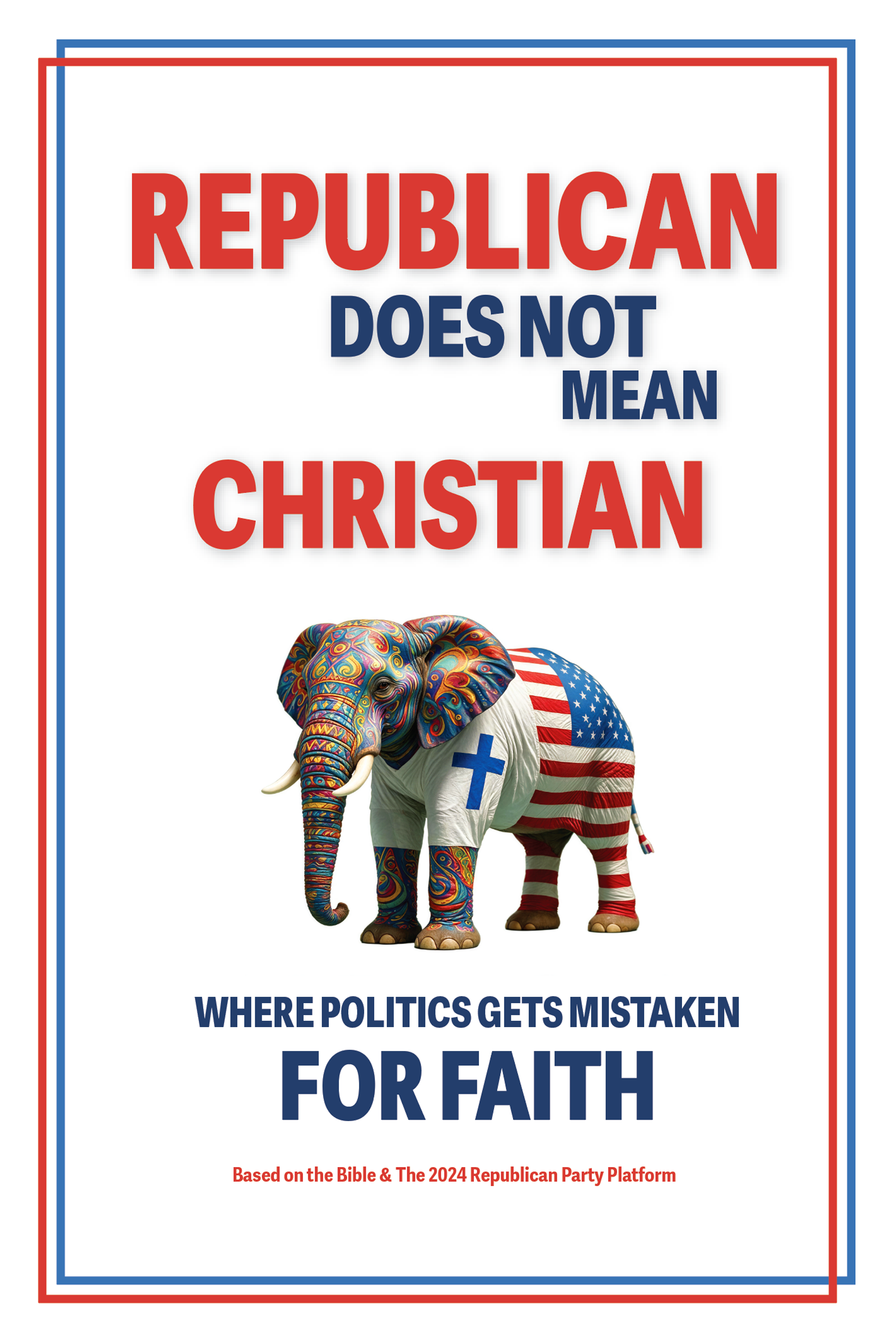
You are currently viewing this book

Click here to read the entire book one of this two-part series
Republican Does Not Mean Christian: Where Politics Gets Mistaken For Faith - Chapter 4
Based On The Bible & U.S. Republican Party Platform For 2024
God’s Word Does Not Change With Time
Quick Links to Each Chapter
__________
Many people today live with the assumption that almost everything eventually changes. Culture changes. Governments change. Political parties change. Moral attitudes that once seemed firmly established can weaken within a generation, while ideas once considered unacceptable can become commonplace. Because change surrounds us, it can become easy to think of Christianity in the same way—as though its teachings must periodically be reconsidered so they remain compatible with the society in which Christians happen to live. But Christianity makes a very different claim about itself. Isaiah 40:8 says, “The grass withers, the flower fades, but the word of our God will stand forever.” Jesus says in Matthew 24:35, “Heaven and earth will pass away, but my words will not pass away.” Hebrews 13:8 tells us that “Jesus Christ is the same yesterday and today and forever.” The Christian claim is not that cultures stop changing. It is that the truth by which those cultures are measured does not change with them.
The history of the Republican Party makes that distinction especially important. The Republican Party of today is not identical to the Republican Party of Abraham Lincoln, Theodore Roosevelt, Dwight Eisenhower, Ronald Reagan, George W. Bush, or even the party that existed immediately before Donald Trump’s rise. Its coalitions, priorities, rhetoric, economic policies, approach to trade, immigration policies, and understanding of America’s role in the world have changed over time. Future Republicans will change the party again. Some of those changes may be wise, some may be mistaken, and others may simply reflect new circumstances. That is what political institutions do. Christianity, however, cannot move every time a political party moves because Christianity does not derive its authority from a political party.
That difference becomes especially important when a political party agrees with Christians on issues they consider morally significant. Agreement naturally creates trust. When Republicans defend unborn life, religious liberty, parental responsibility, the biological distinction between male and female, marriage, or family, Christians who understand those positions as consistent with Scripture may find substantial reason to support them. There is nothing inconsistent about acknowledging genuine agreement. The danger begins when repeated agreement quietly changes the direction of authority. The Christian should support a Republican position because he believes it agrees with Scripture. He should never conclude that a position agrees with Scripture simply because the Republican Party supports it.
What Defines Christianity
This distinction becomes clearer when we ask a more fundamental question: What actually makes Christianity Christian? Christianity has been treated throughout history as many things—a family tradition, cultural inheritance, moral framework, national identity, church affiliation, or political label. A person can attend church, read Scripture, participate in Christian causes, support Christian organizations, and strongly identify with positions commonly associated with Christians. Yet Jesus Himself warns that merely identifying with Him is not the same thing as belonging to Him. In Matthew 7:21 He says, “Not everyone who says to me, ‘Lord, Lord,’ will enter the kingdom of heaven.”
Christianity begins somewhere much deeper than political agreement. Paul teaches that salvation comes through Christ rather than political behavior, good works, cultural identity, or human achievement. Romans 10:9–10 speaks of confessing Jesus as Lord and believing that God raised Him from the dead.
Brothers, my heart’s desire and prayer to God for them is that they may be saved. For I bear them witness that they have a zeal for God, but not according to knowledge. For, being ignorant of the righteousness of God, and seeking to establish their own, they did not submit to God’s righteousness. For Christ is the end of the law for righteousness to everyone who believes. For Moses writes about the righteousness that is based on the law, that the person who does the commandments shall live by them. But the righteousness based on faith says, “Do not say in your heart, ‘Who will ascend into heaven?’” (that is, to bring Christ down) “or ‘Who will descend into the abyss?’” (that is, to bring Christ up from the dead). But what does it say? “The word is near you, in your mouth and in your heart” (that is, the word of faith that we proclaim); because, if you confess with your mouth that Jesus is Lord and believe in your heart that God raised him from the dead, you will be saved. For with the heart one believes and is justified, and with the mouth one confesses and is saved. For the Scripture says, “Everyone who believes in him will not be put to shame.” For there is no distinction between Jew and Greek; for the same Lord is Lord of all, bestowing his riches on all who call on him. For “everyone who calls on the name of the Lord will be saved.” How then will they call on him in whom they have not believed? And how are they to believe in him of whom they have never heard? And how are they to hear without someone preaching? And how are they to preach unless they are sent? As it is written, “How beautiful are the feet of those who preach the good news!” But they have not all obeyed the gospel. For Isaiah says, “Lord, who has believed what he has heard from us?” So faith comes from hearing, and hearing through the word of Christ. But I ask, have they not heard? Indeed they have, for “Their voice has gone out to all the earth, and their words to the ends of the world.”
But I ask, did Israel not understand? First Moses says, “I will make you jealous of those who are not a nation; with a foolish nation I will make you angry.” Then Isaiah is so bold as to say, “I have been found by those who did not seek me; I have shown myself to those who did not ask for me.” But of Israel he says, “All day long I have held out my hands to a disobedient and contrary people.”
—Romans 10:1-21
You yourselves know how I lived among you the whole time from the first day that I set foot in Asia, serving the Lord with all humility and with tears and with trials that happened to me through the plots of the Jews; how I did not shrink from declaring to you anything that was profitable, and teaching you in public and from house to house, testifying both to Jews and to Greeks of repentance toward God and of faith in our Lord Jesus Christ. And now, behold, I am going to Jerusalem, constrained by the Spirit, not knowing what will happen to me there, except that the Holy Spirit testifies to me in every city that imprisonment and afflictions await me. But I do not account my life of any value nor as precious to myself, if only I may finish my course and the ministry that I received from the Lord Jesus, to testify to the gospel of the grace of God. And now, behold, I know that none of you among whom I have gone about proclaiming the kingdom will see my face again. Therefore I testify to you this day that I am innocent of the blood of all, for I did not shrink from declaring to you the whole counsel of God. Pay careful attention to yourselves and to all the flock, in which the Holy Spirit has made you overseers, to care for the church of God, which he obtained with his own blood. I know that after my departure fierce wolves will come in among you, not sparing the flock; and from among your own selves will arise men speaking twisted things, to draw away the disciples after them. Therefore be alert, remembering that for three years I did not cease night or day to admonish every one with tears. And now I commend you to God and to the word of his grace, which is able to build you up and to give you the inheritance among all those who are sanctified. I coveted no one’s silver or gold or apparel. You yourselves know that these hands ministered to my necessities and to those who were with me. In all things I have shown you that by working hard in this way we must help the weak and remember the words of the Lord Jesus, how he himself said, ‘It is more blessed to give than to receive.’ And when he had said these things, he knelt down and prayed with them all. And there was much weeping on the part of all; they embraced Paul and kissed him, being sorrowful most of all because of the word he had spoken, that they would not see his face again. And they accompanied him to the ship.
—Acts 20:18-38
But God, being rich in mercy, because of the great love with which he loved us, even when we were dead in our trespasses, made us alive together with Christ—by grace you have been saved—and raised us up with him and seated us with him in the heavenly places in Christ Jesus, so that in the coming ages he might show the immeasurable riches of his grace in kindness toward us in Christ Jesus. For by grace you have been saved through faith. And this is not your own doing; it is the gift of God, not a result of works, so that no one may boast. For we are his workmanship, created in Christ Jesus for good works, which God prepared beforehand, that we should walk in them.
—Ephesians 2:1-10
That matters because Christian faith contains a claim of authority. To call Jesus Lord means more than believing certain facts about Him or appreciating certain teachings that happen to correspond with our existing beliefs. Christians will sin. They will misunderstand things. They will fail morally and need forgiveness throughout their lives. Christianity does not teach that salvation is earned through perfect behavior. But repentance does mean that the Christian does not retain final authority to decide that something God calls sin is no longer sin simply because obedience has become difficult, culturally unpopular, or politically inconvenient. The Christian claim is that Christ remains Lord even when following Him becomes costly.
That is where political identity can become dangerous. A person may become so accustomed to thinking of himself as both Christian and Republican that the two identities begin to merge. As long as Republican positions correspond with his understanding of Scripture, the problem may remain almost invisible. But suppose the party changes. Which identity determines what happens next? If the Republican position changes while Scripture does not, does the Christian remain where Scripture stands, or does his interpretation of Christianity begin moving with his political party?
Changing Christianity Without Changing a Verse
There is more than one way to change Christianity. The obvious way is to change the meaning of a biblical teaching so that it conforms to what the surrounding culture wants to believe. But there is a subtler way that does not require changing the wording of a single verse. Christians can leave every verse in the Bible exactly where it is while gradually changing which verses receive serious attention.
A Christian might vigorously defend biblical teaching concerning abortion, marriage, sexuality, biological sex, and religious liberty while becoming considerably less concerned about biblical teaching concerning truthfulness, pride, partiality, greed, mercy, vengeance, sexual conduct, treatment of enemies, or the dignity of people outside his political coalition. Nothing has been removed from the Bible. No verse has been rewritten. Instead, different biblical commands begin receiving different weight according to whether they help or complicate the political cause. The sin of an opponent becomes evidence of moral corruption, while the same sin in an ally becomes a personality flaw, strategic necessity, exaggeration, private weakness, or something that should simply be overlooked because more important political objectives are at stake.
That is a genuine danger because selective obedience can preserve the appearance of biblical faithfulness while slowly transferring authority somewhere else. The question is no longer simply, “What does Scripture say?” It becomes, perhaps without the Christian realizing it, “Which parts of Scripture matter most for what we are trying to accomplish?” Once that happens, the Bible may still be quoted frequently while political necessity has begun determining which biblical teachings receive emphasis.
The solution is not to become suspicious of every place where Republicans and Christians agree. Genuine agreement should be acknowledged. If a Republican position corresponds with biblical teaching, there is no virtue in pretending otherwise. Truth does not become less true because a political party happens to affirm it. The important question is whether Scripture remains free to challenge the same political movement when the agreement ends.
The Bible’s Clarity About Sin
Scripture speaks plainly about many moral matters. Murder, adultery, theft, false witness, sexual immorality, idolatry, greed, injustice, hatred, and other sins do not become righteous because a culture approves them. Biblical morality is not established by opinion polls, elections, legislation, judicial decisions, political platforms, or the popularity of the person committing the act. If God’s Word is the standard, it remains capable of judging the behavior of political allies as readily as it judges the behavior of political opponents.
Consistency becomes difficult precisely where our loyalties are strongest. If sexual morality does not change because culture changes, neither does the command against false witness. If God’s created order does not change because public opinion changes, neither does His condemnation of pride. If human life does not lose its value because protecting it becomes politically inconvenient, neither does the dignity of another person disappear because that person belongs to another country, religion, political movement, or social group. Christians cannot reasonably demand that the surrounding culture accept difficult biblical teachings while granting themselves permission to disregard difficult biblical teachings whenever those teachings interfere with their own political objectives.
At the same time, an unchanging Bible does not mean every political judgment becomes an unchanging biblical doctrine. Scripture gives moral boundaries without providing a modern political platform. Christians still have to exercise judgment about economics, administration, foreign affairs, immigration procedures, environmental policy, healthcare, taxation, national defense, and countless other questions. The fact that God’s moral standard does not change should make Christians more careful about distinguishing God’s commands from their own conclusions, not less careful. Where Scripture speaks clearly, political convenience cannot overrule it. Where Scripture leaves room for judgment, political preference should not be elevated into divine command.
The Apostles Did Not Change the Standard for Their Audience
The apostles provide a remarkable example of this distinction because they carried the same Christian message into dramatically different environments. Paul spoke among philosophers in Athens, Christians surrounded by Corinthian sexual immorality, converts in Ephesus, religious Jews in Jerusalem, Roman officials, prisoners, merchants, laborers, wealthy patrons, and people whose economic interests could be disrupted by the spread of Christianity. His audiences changed. Their cultures changed. The particular sins and questions before him changed. Yet the underlying message did not become a different Christianity every time Paul entered another city.
In Athens, Paul acknowledged the religious awareness of his audience but still called people to repentance. In Corinth, he confronted sexual immorality while reminding believers that grace had transformed people who had once lived in those sins. In Ephesus, conversion led people to abandon practices from which they had previously benefited. In Jerusalem, Peter called deeply religious people to repentance rather than assuming that religious identity made repentance unnecessary. In Philippi, Paul’s intervention involving an exploited slave girl threatened the financial interests of those profiting from her. Christianity could confront sexuality, religion, economics, power, culture, and personal behavior because none of those things possessed authority over the message itself.
The apostles did not need to condemn every possible sin in every sermon in order to remain consistent. They addressed the circumstances actually before them. But the standard by which those circumstances were judged did not change according to the audience. That distinction matters. Consistency does not require Christians to speak about every issue with equal frequency. It requires that when an issue does arise, the identity of the person involved does not determine whether the biblical standard still applies.
That principle becomes especially important in politics. Christians cannot establish one moral standard for opponents and another for allies. Dishonesty does not become honest because it helps accomplish something desirable. Sexual immorality does not cease being sexual immorality because the person involved supports policies Christians consider important. Pride does not become humility because it appears in a leader we admire. At the same time, recognizing someone’s moral failure does not automatically answer every prudential question about voting, governing, or public policy. There is an important difference between deciding how to act in an imperfect political world and redefining wrongdoing so that we no longer have to admit it is wrong.
When the Party Changes
The easiest way to see why all of this matters is to imagine tomorrow’s Republican Party rather than today’s. Suppose a future Republican platform concludes that electoral success requires abandoning opposition to abortion altogether. Would unborn life suddenly possess less value? Suppose a future Republican coalition decides that traditional Christian teaching concerning marriage has become politically inconvenient. Would Matthew 19 change? Suppose Republicans someday conclude that religious liberty should protect Christians but not an unpopular religious minority. Would biblical principles concerning justice and impartiality disappear because the party had changed its political calculation?
If the answer is no, then the Republican Party cannot be the foundation upon which those convictions rest. Republicans do not own the biblical concern for life because they presently defend it. They do not own a Christian understanding of biological sex because their current platform opposes attempts to redefine it. They do not own marriage, family, parental responsibility, religious liberty, truth, justice, or morality. If those convictions are genuinely Christian, they must remain true when Republicans affirm them, when Republicans ignore them, and even if Republicans someday oppose them.
The reverse matters just as much. If Republicans change a tax policy, tariff policy, immigration procedure, healthcare proposal, environmental regulation, or military strategy, Christians should not automatically conclude that the old Republican position was biblical and the new one is unbiblical. Scripture never established every detail of either policy in the first place. Political parties must be able to respond to changing circumstances, and Christians need enough humility to recognize the difference between changing a political judgment and changing a biblical command. Otherwise, a political preference can quietly become a religious doctrine simply because Christians have defended it long enough.
This is why an unchanging standard provides both restraint and freedom. Christians are restrained from changing what Scripture clearly teaches simply because political circumstances have changed. But they are also free to change their minds about matters Scripture has left to wisdom and judgment. They can reconsider a tax policy without reconsidering Christianity. They can change their view of a tariff without changing Scripture. They can conclude that an immigration procedure is ineffective without abandoning biblical truth. Political judgment can change because circumstances and evidence change. God’s moral authority does not depend upon either.
Proof Through the Apostles’ Commitment
The apostles provide one final reminder of how seriously the earliest Christians regarded the message they proclaimed. They did not appear to understand Christianity as a flexible religious identity that could be adjusted whenever maintaining it became uncomfortable. Acts records imprisonment, threats, beatings, and persecution, while Paul’s letters describe repeated suffering connected with his ministry. Whatever conclusions we ultimately draw from later traditions concerning the deaths of particular apostles, the New Testament itself leaves little doubt that the earliest Christian witnesses expected faithfulness to their message to carry real personal cost.
We will examine the historical evidence surrounding the apostles and their deaths more fully in the chapter: Anchored in More Than Faith. Not every traditional account concerning an apostle’s death rests upon evidence of equal historical strength, and there is no reason to exaggerate the evidence in order to make the point. The point needed here is simpler. The earliest Christian witnesses behaved as though the message they proclaimed stood above the pressures being placed upon them. They could be threatened because of it, beaten because of it, imprisoned because of it, and in some cases killed in connection with proclaiming it. They understood themselves as accountable to the truth they had received, not authorized to rewrite that truth whenever maintaining it became costly.
That is what makes the relationship between Christianity and any political party so important. Political parties survive by changing. They build coalitions, respond to elections, revise priorities, replace leaders, alter platforms, and adapt to circumstances. Christianity makes a fundamentally different claim. It claims that Christ does not need to be revised when the electorate changes.
Culture changes. Political parties change. Churches can change. Individual Christians can change. That is precisely why none of them can be the Christian’s final measuring line. Today’s political agreement may become tomorrow’s political disagreement, and a party that presently stands beside Christians on an important issue may eventually walk away from them. If that day comes, Christianity cannot follow merely because Christians have grown comfortable standing beside the party.
The Christian foundation must therefore remain somewhere the political party cannot move. If Christ is truly Lord, the responsibility of the Christian is not to move Him wherever politics happens to go. It is to remain anchored to Him when everything else moves.
Sources: Specific text assignment for each footnote in printed edition
-
Republican National Committee, The 2024 Republican Platform: Make America Great Again! 43rd Republican National Convention, 2024.
-
Republican National Committee, 2024 Republican Platform, p. 20. – American Society for Reproductive Medicine, Ethics Committee, “Disposition of Unclaimed Embryos: An Ethics Committee Opinion,” Fertility and Sterility
-
Practice Committee of the American Society for Reproductive Medicine, “Comprehensive Guidance for Human Embryology, Andrology, and Endocrinology Laboratories: Management and Operations: A Committee Opinion,” Fertility and Sterility, vol. 117, no. 6 (2022): 1183–1202; Ethics Committee of the American Society for Reproductive Medicine, “Disposition of Unclaimed Embryos: An Ethics Committee Opinion,” Fertility and Sterility, vol. 116, no. 1 (2021): 48–53.
-
Democratic National Committee, 2024 Democratic Party Platform, 2024.
All sources identified as footnotes in printed text
Additional Matter Of Fact Books
Click image to find out more.



Matter Of Fact Books
Our books are priced to sell and change lives.