
God, Politics & Party
A Two-Part Series for Those Who Struggle With Where Politics Ends and Faith Begins
“Every generation faces its own battle for truth, and ours is no different. The danger today is not persecution from without, but deception from within. The most effective lies are not shouted in rebellion but whispered in the language of love, progress, and compassion. They sound noble, they feel kind, and they appear moral — yet they slowly replace obedience with emotion, and truth with tolerance.” — C. J. Bartels
Matter of Fact Books is making both books available to read free of charge for a limited time, in the hope that, if you identify as a Christian, you will truly understand what you have chosen to believe.
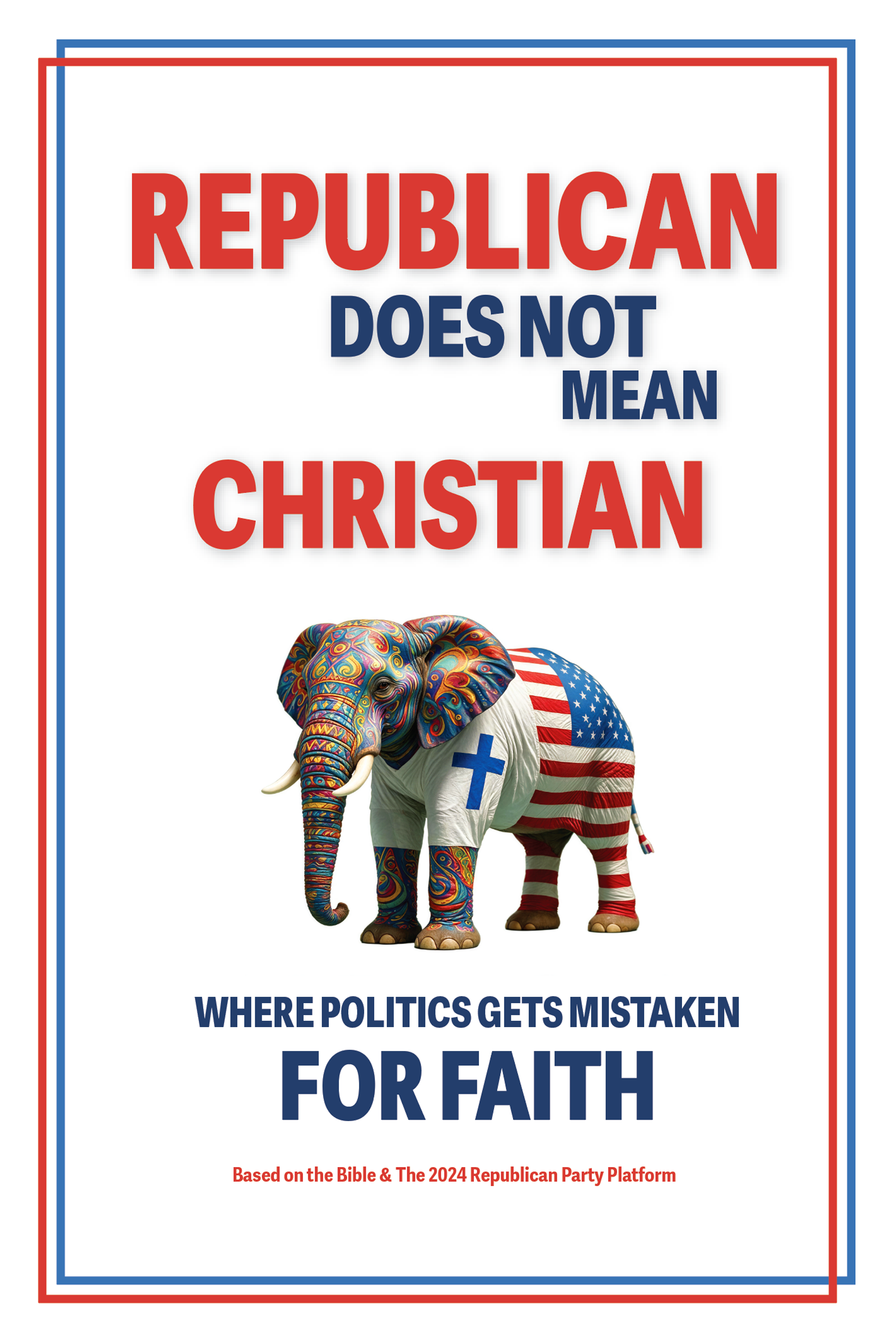
You are currently viewing this book

Click here to read the entire book one of this two-part series
Republican Does Not Mean Christian: Where Politics Gets Mistaken For Faith - Chapter 3
Based On The Bible & U.S. Republican Party Platform For 2024
When The Platform Meets Scripture
Quick Links to Each Chapter
__________
The standard for this examination has now been established. The Republican Party must be judged by what it has officially placed in its platform, and that platform must be compared with what Scripture actually establishes rather than with political preferences that Christians may sincerely hold. That distinction matters because applying the standard turns out to be considerably more difficult than simply placing Republican policies beside Bible verses and looking for differences. Some positions correspond closely with biblical principles. Others involve political judgments about which Christians can reasonably disagree. Still others raise serious moral questions without providing enough evidence to say that the Republican Party has explicitly adopted something Scripture clearly condemns. We have established the measuring line. We can now see what happens when it is actually applied.
Immigration and the Foreigner
Immigration initially appears to offer one of the strongest possible contrasts. The Republican platform promises to secure the border, strengthen immigration enforcement, and undertake what it describes as the largest deportation operation in American history. Scripture, meanwhile, repeatedly commands God’s people to treat the foreigner with justice and compassion, and those commands cannot be dismissed merely because immigration has become politically contentious. At the same time, Romans 13 recognizes legitimate civil authority and the government’s authority to restrain wrongdoing:
—Romans 13:1–7
—Leviticus 19:33–34
—Deuteronomy 10:18–19
These verses establish genuine moral obligations concerning the treatment of the foreigner. A Christian cannot simply disregard those obligations because someone entered a country unlawfully or because immigration enforcement has become a political priority. The foreigner remains a human being created in the image of God and must be treated accordingly. But these passages do not say that a civil government cannot maintain a border, establish immigration laws, determine who may legally enter, or remove someone who has violated those laws. Both principles therefore have to remain in view. We cannot simply take the word “deportation,” place it beside “love the stranger,” and announce that we have discovered a biblical contradiction. We would first have to demonstrate that the actual position written in the platform requires conduct Scripture forbids.
A Christian may argue that a particular deportation method is cruel, that an immigration law should be changed, that families should be treated differently, or that mercy should be extended in a particular circumstance. Those are legitimate moral discussions, but the written commitment to enforce immigration law and remove people unlawfully present does not, by itself, establish that those people must be mistreated. The rhetoric surrounding immigration deserves consideration as well. The platform describes illegal immigration as an “invasion,” emphasizes crimes committed by migrants, and repeatedly presents illegal immigration as a threat to American citizens. A Christian can reasonably ask whether political rhetoric about foreigners adequately reflects the dignity Scripture requires Christians to recognize in every person. Yet rhetoric and policy are not identical. Strong or accusatory language may warrant separate examination without establishing that the underlying policy commands hatred, exploitation, cruelty, or denial of human dignity. Immigration therefore illustrates precisely why this examination requires care: Scripture demands just and compassionate treatment of the foreigner, Scripture recognizes civil authority, and the Republican platform advocates aggressive immigration enforcement. Whether a particular implementation of that policy is just or unjust must ultimately be judged according to what that implementation actually requires and does.
Economics, Work, and Government
Much of the Republican platform concerns economics. Republicans advocate tax reductions, deregulation, tariffs, domestic manufacturing, increased energy production, protection of Social Security and Medicare, lower healthcare costs, homeownership incentives, and policies intended to protect American workers. These proposals can have significant consequences, and Christians are free to evaluate those consequences seriously.
Scripture certainly has something to say about economic behavior, and its teaching reaches in several directions that have to be considered together:
- Work and personal responsibility — 2 Thessalonians 3:10–12: Paul instructs those who are able to work to do so and to earn their own living.
- Honest business and fair dealing — Proverbs 11:1: Dishonest weights are condemned, while honest measures are pleasing to God.
- Treatment of workers — Deuteronomy 24:14–15: God’s people are commanded not to oppress poor or vulnerable workers and to pay them what they are owed.
- Generosity and care for those in need — Deuteronomy 15:7–11: God’s people are told not to harden their hearts toward the poor but to give generously to those in need.
- Greed and the pursuit of wealth — Luke 12:15: Jesus warns His followers to guard themselves against covetousness and reminds them that life does not consist in the abundance of possessions.
- Responsibility toward ourselves and others — Galatians 6:2–5: Paul tells Christians to “bear one another’s burdens” while also saying that “each will have to bear his own load.”
Taken together, these passages establish principles of honest work, personal responsibility, fair dealing, generosity, protection of workers, care for the poor, stewardship, and resistance to greed. They should influence how Christians think about economic policy, but they do not automatically produce a single modern economic system. A Christian may believe lower taxes allow families and businesses to use resources more productively, while another may believe additional taxation is justified to provide particular public services. One may believe tariffs protect American workers from unfair foreign competition, while another may believe tariffs increase prices and ultimately harm the very workers they are intended to help. Economists can debate those questions, and Christians can evaluate the human consequences of the competing policies, but Scripture does not provide the federal tax code or specify the tariff that should be placed on an imported automobile.
The same distinction applies to regulation, energy production, healthcare policy, housing incentives, government assistance, and many other economic proposals in the platform. A regulation could be necessary to prevent exploitation, or it could impose unnecessary costs without accomplishing a legitimate purpose. Increased energy production could benefit families through lower costs, while particular methods of production could raise legitimate stewardship concerns. Assistance could provide necessary help to someone genuinely in need, while a poorly designed system could discourage personal responsibility or create unhealthy dependence. Scripture also adds another consideration that can easily be overlooked in political arguments about these programs: neither government nor wealth is ultimately the Christian’s provider. Scripture repeatedly identifies God as the source of what we possess and warns against placing the trust owed to Him in rulers, riches, or human institutions. At the same time, Scripture shows provision occurring through work, families, generosity, communities, and other people. The biblical question is therefore larger than simply asking whether assistance comes from government or somewhere else. Christians must also consider whether a system encourages responsibility, genuinely serves those in need, treats people justly, and avoids encouraging people to place in human institutions the dependence and trust that ultimately belong to God. Scripture gives Christians principles by which those consequences can be considered, but it does not necessarily prescribe the governmental mechanism that must be used to address them. Those questions require wisdom, evidence, and judgment, and they should not be transformed into direct biblical commands simply because Christians disagree strongly about their consequences.
Education, Parents, and Children
The Republican platform also places substantial emphasis on education. It supports school choice, homeschooling, parental rights, career education, school discipline, local control, religious liberty in education, and removing what it describes as political and gender indoctrination from taxpayer-supported schools. Several principles in that section can readily be considered alongside Scripture. Christianity gives parents serious responsibilities concerning the upbringing and instruction of their children. Religious liberty allows Christian parents and students to live according to their convictions without government coercion. Christians who understand Scripture as teaching that God created humanity male and female can also find substantial agreement with platform provisions resisting governmental attempts to redefine biological sex.
Agreement with those principles, however, does not transform every Republican education proposal into a biblical requirement. Scripture does not establish whether the federal Department of Education should exist. It does not specify how public schools should be funded, whether school-choice programs produce better or worse educational outcomes, or what administrative responsibilities should belong to federal, state, or local governments. A Christian may support the platform’s proposed method or prefer another method while affirming many of the same underlying moral principles. That distinction works in both directions. We should not call a Republican education proposal biblical merely because we favor it, but neither should we call it unbiblical merely because another political arrangement might work better. The biblical question concerns the moral principle, while the political question often concerns the best means of applying it.
Law, Authority, and Justice
The platform places similar emphasis on law and order. It advocates stronger support for law enforcement, punishment of violent offenders, enforcement of immigration laws, action against gangs and cartels, and greater accountability within government. Scripture does not condemn civil authority merely for enforcing law. Romans 13 explicitly recognizes governmental authority to punish wrongdoing. At the same time, Scripture repeatedly demands justice and impartiality and condemns corruption, false accusation, oppression, and abuse of power. Government therefore possesses legitimate authority, but possessing authority does not make every use of that authority just.
That distinction prevents us from reaching conclusions in advance of the evidence. A government could implement a law-enforcement policy unjustly. Police officers can abuse authority, prosecutors can act improperly, courts can make unjust decisions, and governments can punish innocent people. If those things occur, the particular injustice can and should be examined against Scripture. But the possibility that governmental authority can be abused does not establish that the existence or enforcement of law is itself contrary to Scripture. The Republican platform’s law-and-order provisions therefore have to be judged according to what they actually establish and, where implementation becomes relevant, according to what government actually does. We cannot treat hypothetical misconduct as though that misconduct were already written into the platform.
“America First”
The platform’s “America First” philosophy raises a different kind of question because Christianity is not ultimately nationalistic. Christ did not die for Americans alone. The Great Commission does not distinguish between people according to citizenship, and Revelation describes the redeemed as coming from every tribe, language, people, and nation. Christianity does not permit an American Christian to conclude that an American life possesses greater value before God than the life of someone born in Mexico, China, Nigeria, Ukraine, Israel, Russia, Canada, or anywhere else. A Christian’s ultimate allegiance therefore cannot terminate with the United States. If “America First” meant America above God, American interests regardless of justice, or American lives possessing greater moral value than other human lives, a serious biblical problem would immediately arise.
But that is not the only possible meaning of a government placing its own country first. Governments necessarily exercise responsibilities within jurisdictions. American officials are elected or appointed to administer the government of the United States, just as a governor has particular responsibilities toward the people of a state. Parents have particular responsibilities toward their own children without believing other children possess less human worth. Particular responsibility does not necessarily establish greater human value. The question, therefore, is what “America First” actually requires. A government giving particular attention to the security, prosperity, and welfare of the people it governs is not automatically equivalent to a Christian placing America above Christ. National interest could become idolatrous or unjust, and Christians should remain alert to that possibility, but the phrase itself cannot bear more weight than the written policies attached to it. If a policy requires injustice toward another people in order to benefit Americans, that injustice should be examined. If it simply prioritizes responsibilities associated with governing the United States, the biblical conclusion is considerably less obvious.
Military Strength and Peace
Military policy presents a similar problem. The Republican platform calls for strengthening and modernizing the military and presents that strength primarily as a means of deterrence, national security, and what it describes as “peace through strength.” Christians have disagreed about war throughout much of church history. Some Christian traditions embrace pacifism, while others accept versions of just-war reasoning and recognize the authority of governments to defend their populations. Scripture clearly condemns murder, cruelty, injustice, vengeance, and the shedding of innocent blood, but those prohibitions do not by themselves establish that maintaining a military is sinful.
The moral questions therefore arise largely in how military power is used. A powerful military can be used defensively or aggressively. It can deter violence or participate in it. It can protect innocent people or harm them. Those distinctions matter enormously from a Christian perspective, yet the platform’s desire to possess an exceptionally strong military does not by itself tell us which of those moral choices will be made. Christians can disagree about the size of the defense budget, the wisdom of particular weapons systems, overseas deployments, military alliances, foreign intervention, and the degree to which military strength actually produces peace. Those disagreements may be extremely important, but they are not automatically disagreements over a command explicitly given in Scripture.
Positions That Present Little Direct Conflict
Other portions of the platform move even further away from anything that could reasonably be described as a direct biblical contradiction. Protecting Social Security and Medicare, helping elderly people remain in their homes, supporting family caregivers, lowering healthcare costs, assisting veterans, opposing antisemitism, protecting religious liberty, defending free speech, promoting marriage and family, and preserving natural resources do not naturally stand opposite clear biblical commands. That does not mean every proposed method of accomplishing those goals is wise. A Christian can support helping elderly people while disagreeing about the structure of Medicare, support veterans while questioning a particular federal program, or value conservation while disagreeing about environmental regulation. Agreement about a goal does not require agreement about the governmental mechanism used to pursue it. This is where the distinction between biblical principle and political administration becomes particularly important. Christianity can tell us something about why people matter without necessarily telling Congress exactly how a program serving those people must be constructed.
Abortion and the Meaning of Life
Abortion requires considerably closer examination because here the underlying moral question is not merely administrative. The Republican platform states that Republicans “proudly stand for families and Life.” It invokes the Fourteenth Amendment’s guarantee that no person can be denied life or liberty without due process, states that authority to legislate on abortion has been returned to the states and voters, and specifically promises opposition to late-term abortion. For Christians who believe Scripture establishes the moral value of human life from conception, an obvious question follows. If the unborn child possesses moral value before God, why specifically identify late-term abortion? If human value begins before birth, that value does not suddenly appear at a particular week of pregnancy. Nor would the child’s underlying human value logically depend upon whether the child happens to be located in Minnesota, Texas, California, or Florida.
Psalm 139 describes God’s intimate knowledge of the child being formed in the womb.
You know when I sit down and when I rise up; you discern my thoughts from afar.
You search out my path and my lying down and are acquainted with all my ways.
Even before a word is on my tongue, behold, O LORD, you know it altogether.
You hem me in, behind and before, and lay your hand upon me.
Such knowledge is too wonderful for me; it is high; I cannot attain it.
Where shall I go from your Spirit? Or where shall I flee from your presence?
If I ascend to heaven, you are there! If I make my bed in Sheol, you are there!
If I take the wings of the morning and dwell in the uttermost parts of the sea,
even there your hand shall lead me, and your right hand shall hold me.
If I say, “Surely the darkness shall cover me, and the light about me be night,”
even the darkness is not dark to you; the night is bright as the day, for darkness is as light with you.
For you formed my inward parts; you knitted me together in my mother’s womb.
I praise you, for I am fearfully and wonderfully made. Wonderful are your works; my soul knows it very well.
My frame was not hidden from you, when I was being made in secret, intricately woven in the depths of the earth.
Your eyes saw my unformed substance; in your book were written, every one of them, the days that were formed for me, when as yet there was none of them.
How precious to me are your thoughts, O God! How vast is the sum of them!
If I would count them, they are more than the sand. I awake, and I am still with you.
Oh that you would slay the wicked, O God! O men of blood, depart from me!
They speak against you with malicious intent; your enemies take your name in vain.
Do I not hate those who hate you, O LORD? And do I not loathe those who rise up against you?
I hate them with complete hatred; I count them my enemies.
Search me, O God, and know my heart! Try me and know my thoughts!
And see if there be any grievous way in me, and lead me in the way everlasting!
—Psalm 139
—Jeremiah 1:5
—Luke 1:41-44
Intellectual honesty, however, requires us to stop one step short of saying something the document does not say. The platform does not state that early abortion is morally acceptable. It does not expressly endorse first-trimester abortion. Its explicit language identifies the party with life, opposes late-term abortion, and leaves substantial legislative authority with states and voters. That produces a serious tension. A Christian can question whether leaving legal protection to the states is morally consistent with the premise that unborn children possess an inherent right to life. A Christian can also question why late-term abortion receives specific opposition if the underlying moral principle begins at conception. But under the standard of this book, failure to explicitly oppose every abortion cannot simply be rewritten as an affirmative endorsement of abortion. Incomplete opposition and affirmative support are not identical claims. That distinction may frustrate someone who wants a cleaner answer, but changing the meaning of the platform to produce that answer would undermine the very examination we are attempting to conduct.
IVF and the Unresolved Embryo Question
In vitro fertilization creates another difficult question because the Republican platform explicitly supports access to IVF. For Christians who believe human life begins at conception, some practices associated with IVF can raise profound moral concerns. IVF may result in multiple embryos being created, embryos being cryopreserved, embryos being selected for transfer, and circumstances in which embryos are eventually discarded or destroyed. If an embryo is already human life possessing moral value before God, then intentionally destroying that embryo would not become morally insignificant merely because conception occurred in a laboratory rather than within a woman’s body. The desire of a married couple to have a child is understandable, and infertility can involve profound grief. Recognizing a moral question surrounding particular reproductive practices should not require Christians to treat that grief casually or to assume wrongful motives on the part of people seeking fertility treatment. The moral question concerns what may happen to embryonic human life within particular procedures.
The same discipline used throughout this examination must therefore apply here. The platform explicitly supports access to in vitro fertilization. A Christian who believes human life begins at conception may have serious moral concerns about IVF practices that may create more embryos than will ultimately be transferred, indefinitely freeze embryos, select among them, or ultimately result in their destruction. Those concerns deserve careful examination. But the Republican platform does not say that embryos should be destroyed, and IVF does not inherently require the destruction of embryos. The platform supports IVF without defining every procedure or practice that may occur within it. If an argument against the platform requires us to insert embryo destruction into a sentence where the party itself did not put it, then we have moved from examining what the platform says to examining what can occur in the implementation of something the platform supports.
That distinction does not make the embryo question disappear. Quite the opposite. The platform’s broad support for IVF leaves unresolved an important question about how that support relates to its stated commitment to life. If life deserves protection from conception, then Christians have legitimate reason to ask what protections should apply to embryos created through IVF. The platform does not answer that question. That may establish a serious moral tension, but it does not automatically establish the kind of direct written contradiction this book requires for a position to be identified as explicitly contrary to Scripture.
What the Comparison Actually Found
After examining these and the other major positions contained in the 2024 Republican platform, the result is more complicated than simply assembling a list of Republican policies with which Christians might disagree. There are Republican positions that correspond with biblical principles. There are policies involving economic, administrative, military, educational, and governmental judgments about which Christians can reasonably disagree. There are policies whose implementation could become unjust or unbiblical even though the written policy does not require that result. And there are areas—particularly abortion and IVF—where the platform leaves serious questions unresolved for Christians attempting to apply a consistent conception-based understanding of human life. What I do not find, under the narrow standard established for this book, is an official platform position that clearly requires a Christian to affirm something Scripture clearly condemns.
There is an important limitation to that conclusion that should not be overlooked. The 2024 Republican platform is a comparatively short document that frequently establishes broad goals and principles without providing extensive detail about how every position would be implemented. That is different from the 2024 Democratic platform, which is considerably longer and frequently describes policies, proposed actions, and governing priorities in greater detail. A more detailed document naturally provides more specific statements to examine. A shorter platform leaves more questions unanswered. The absence of an explicit contradiction in the Republican platform therefore cannot be turned into a claim about positions the platform never addresses. It means only that the written statements actually contained in the document have been examined according to the standard established in this book.
That distinction is important precisely because the standard cannot change according to the result we want. If the purpose were to construct the strongest possible case against Republicans, the evidence could be broadened considerably. Statements from Republican politicians could be collected, and campaign rallies, interviews, social-media posts, state legislation, conservative organizations, political commentators, outside policy proposals, and the personal conduct of individual leaders could all be examined. Some of that material could raise separate Christian questions, but it would answer a different question. This book asks what the Republican Party has officially placed into its national platform and what happens when those written positions are compared with Scripture. Once that boundary is established, it has to remain in place even when breaking it would make an argument easier.
No Contradiction Does Not Mean No Concern
The absence of a clear direct contradiction does not mean there is nothing for Christians to examine. Abortion and IVF expose genuine unresolved questions within the platform’s stated commitment to life. Immigration policy could be implemented in ways that honor human dignity or in ways that violate it. Law-enforcement authority can be exercised justly or abused. Military strength can deter aggression or be used unjustly. Economic policies can produce intended benefits or unintended harms. “America First” can describe a government’s particular responsibility toward its citizens, or national loyalty can become something much more dangerous if it begins overriding justice or allegiance to God. A Christian therefore should never confuse “not explicitly contrary to Scripture” with “necessarily wise, compassionate, just, or Christian.” Those are different conclusions.
The Standard Applies to the Christian Too
There is another distinction in Scripture that deserves consideration before moving on, particularly in a book examining politics through a Christian lens. Paul makes an interesting distinction in 1 Corinthians 5 between people who make no claim to Christianity and those who identify themselves as fellow believers. He explains that when he warned Christians about associating with people engaged in serious sin, he was not telling them to separate themselves from every unbeliever who lived contrary to Christian teaching. As Paul points out, doing that would require Christians to remove themselves from the world altogether. His stronger warning was directed toward the person who claimed to be a brother while continuing in conduct contrary to the faith he professed.
It is actually reported that there is sexual immorality among you, and of a kind that is not tolerated even among pagans, for a man has his father’s wife. And you are arrogant! Ought you not rather to mourn? Let him who has done this be removed from among you. For though absent in body, I am present in spirit; and as if present, I have already pronounced judgment on the one who did such a thing. When you are assembled in the name of the Lord Jesus and my spirit is present, with the power of our Lord Jesus, you are to deliver this man to Satan for the destruction of the flesh, so that his spirit may be saved in the day of the Lord. Your boasting is not good. Do you not know that a little leaven leavens the whole lump? Cleanse out the old leaven that you may be a new lump, as you really are unleavened. For Christ, our Passover lamb, has been sacrificed. Let us therefore celebrate the festival, not with the old leaven, the leaven of malice and evil, but with the unleavened bread of sincerity and truth. I wrote to you in my letter not to associate with sexually immoral people—not at all meaning the sexually immoral of this world, or the greedy and swindlers, or idolaters, since then you would need to go out of the world. But now I am writing to you not to associate with anyone who bears the name of brother if he is guilty of sexual immorality or greed, or is an idolater, reviler, drunkard, or swindler—not even to eat with such a one. For what have I to do with judging outsiders? Is it not those inside the church whom you are to judge? God judges those outside. “Purge the evil person from among you.”
—1 Corinthians 5
That distinction is worth remembering when Christianity and politics become closely associated. It would be easy for a Christian to examine the conduct of people outside the faith with great precision while becoming considerably less demanding when examining a political leader, movement, or fellow believer with whom he agrees. Scripture does not give us that option. Nor does it permit us to choose only those sins that are politically convenient to condemn. Sexual immorality remains sexual immorality, greed remains greed, dishonesty remains dishonesty, reviling remains reviling, and idolatry remains idolatry regardless of whether the person committing them votes as we do. If anything, Paul’s words suggest that a profession of Christian faith gives believers more reason to take the inconsistency seriously, not less.
This does not change the method used to evaluate the Republican platform. An individual’s conduct still cannot be inserted into the platform and presented as an official Republican position. It does, however, provide an important reminder about the larger purpose of this examination. The goal is not to search Scripture for isolated verses that can be used against a political party while ignoring other passages that make us uncomfortable. Scripture has to remain the standard even when it turns from the political position we are examining and begins examining us. That means reading Romans 13 alongside the commands concerning the foreigner, biblical teaching about sexual morality alongside biblical teaching about greed and the tongue, and biblical teaching about life alongside biblical teaching about justice, mercy, honesty, and love. If Scripture is truly the measuring line, we do not get to decide which parts of the line will be used.
The Warning of Partial Obedience
The account of Saul in 1 Samuel 15 provides an important warning even though this platform examination has not produced a list of direct contradictions.
–1 Samuel 15:22-23
If Republicans defend religious liberty, affirm the importance of family, recognize biological sex, protect parental authority, or take positions intended to protect unborn life, those agreements should be acknowledged where they genuinely exist. But they do not create moral credit that can be accumulated and then spent on a future contradiction. God’s commands are not a political scorecard on which enough correct answers erase deliberate rejection of another command. The reverse is also true. We should not manufacture disagreement merely because we expect a political party to be imperfect. A Christian may prefer one immigration policy over another, one tax system over another, one environmental policy over another, one healthcare structure over another, or one approach to foreign affairs over another. Those questions can involve serious moral considerations, but unless a political position crosses a boundary Scripture actually establishes, disagreement over the policy remains a matter requiring Christian judgment rather than automatically becoming biblical disobedience.
Republican Does Not Mean Christian
This finding helps explain the title of this book. Republican Does Not Mean Christian does not mean that being Republican prevents someone from being Christian. Under the platform-based standard used here, the Republican Party does not presently require its members to affirm an official position that this examination has established as directly contrary to Scripture. But neither does that make Republicanism Christianity. A political party can agree with Scripture in many places without becoming the source of Christian truth. A Christian can support many Republican policies without giving the Republican Party authority over his faith. Christianity existed long before the Republican Party, and its truth does not depend upon whether a Republican platform agrees with it.
That distinction may ultimately be more important than producing a numbered list of contradictions. If the Republican Party changes, Scripture does not change with it. If a future platform adopts a position that clearly conflicts with God’s Word, the Christian’s responsibility would not be to reinterpret Scripture in order to preserve political loyalty. Likewise, if Republicans change a tax policy, tariff, immigration procedure, energy policy, healthcare proposal, or another matter Scripture does not specifically prescribe, Christians should not automatically treat that political change as a departure from God. The challenge is knowing the difference between God’s commands and our political preferences.
We are therefore not looking for a predetermined political answer. We are asking whether there is a biblical answer and allowing the evidence to determine how confidently that answer can be stated. Where the platform corresponds with Scripture, that correspondence should be acknowledged. Where Scripture leaves room for judgment, Christians should resist turning their preferred policy into God’s command. Where the platform creates a genuine unresolved tension, that tension should not be hidden merely because the party is politically familiar. If a direct contradiction appears, Christians should be prepared to recognize it regardless of which political movement asks them to ignore it. That is what it means to place politics beneath faith rather than faith beneath politics. A Republican position does not become Christian merely because Republicans support it, and a political disagreement does not become sinful merely because someone can attach a Bible verse to the opposing side. The measuring line must remain outside the political party itself. For the Christian, that measuring line is the Word of God, and the responsibility is not to force the evidence toward the conclusion we prefer, but to follow it wherever it leads.
Sources: Specific text assignment for each footnote in printed edition
-
Republican National Committee, The 2024 Republican Platform: Make America Great Again! 43rd Republican National Convention, 2024.
-
Republican National Committee, 2024 Republican Platform, p. 20. – American Society for Reproductive Medicine, Ethics Committee, “Disposition of Unclaimed Embryos: An Ethics Committee Opinion,” Fertility and Sterility
-
Practice Committee of the American Society for Reproductive Medicine, “Comprehensive Guidance for Human Embryology, Andrology, and Endocrinology Laboratories: Management and Operations: A Committee Opinion,” Fertility and Sterility, vol. 117, no. 6 (2022): 1183–1202; Ethics Committee of the American Society for Reproductive Medicine, “Disposition of Unclaimed Embryos: An Ethics Committee Opinion,” Fertility and Sterility, vol. 116, no. 1 (2021): 48–53.
-
Democratic National Committee, 2024 Democratic Party Platform, 2024.
All sources identified as footnotes in printed text
Additional Matter Of Fact Books
Click image to find out more.




Matter Of Fact Books
Our books are priced to sell and change lives.