Written for the Muslim Who Is Brave Enough To Examine His or Her Own Faith
As a matter of fact...
Why This Book Was Written
This book is written for the Muslim who takes God seriously. More than two billion people call themselves Muslim. Many of them pray with a sincerity, discipline, and devotion to God that puts much of the Western world to shame. But how many have ever been invited to look carefully at why they believe what they believe?
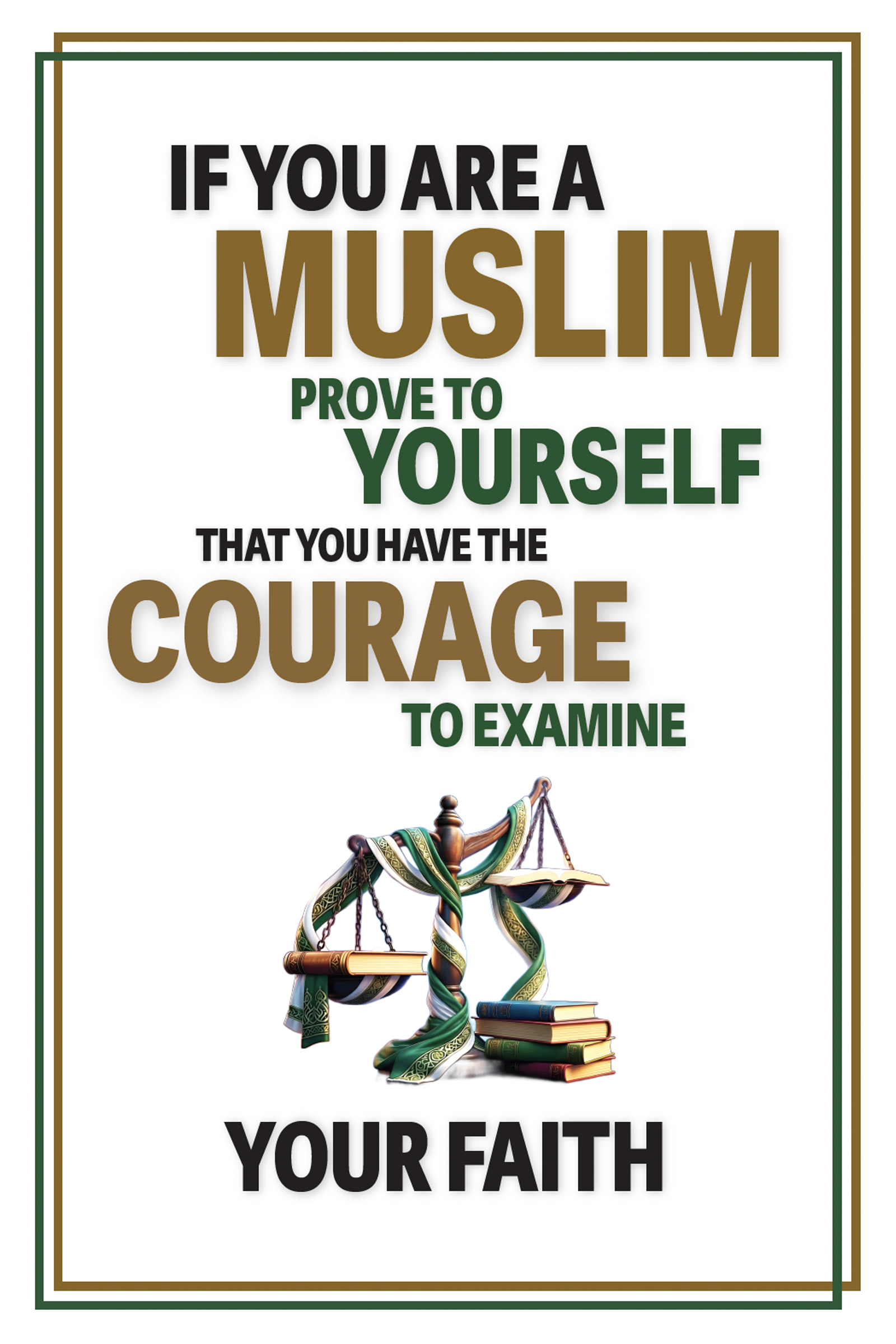
With respect for your devotion and without mockery or hatred, “If You Are a Muslim, Prove To Yourself That You Have The Courage To Examine Your Faith” invites you to examine the foundations of Islam the way many Christians are encouraged to examine their own faith: by looking at history, sources, authorship, and evidence—not just tradition and emotion.
Inside, you’ll explore what the Qur’an actually says and how it relates to the way Islam is practiced today, what the Hadith are and how they came to shape everyday Muslim life, and where Sharia truly comes from and how its primary sources developed. We will also look at who God is as described in both Islam and Christianity and how those claims compare.
And finally, this book is also for the non-Muslim who thinks they already understand Islam—those who assume it is either entirely peaceful or entirely violent, entirely divine or entirely “man-made.” What you’ll discover may challenge long-held assumptions, clarify misunderstandings, and reveal a far more complex and surprising truth than the one most people—on either side—have ever been shown.
It’s time to truly understand what you believe.
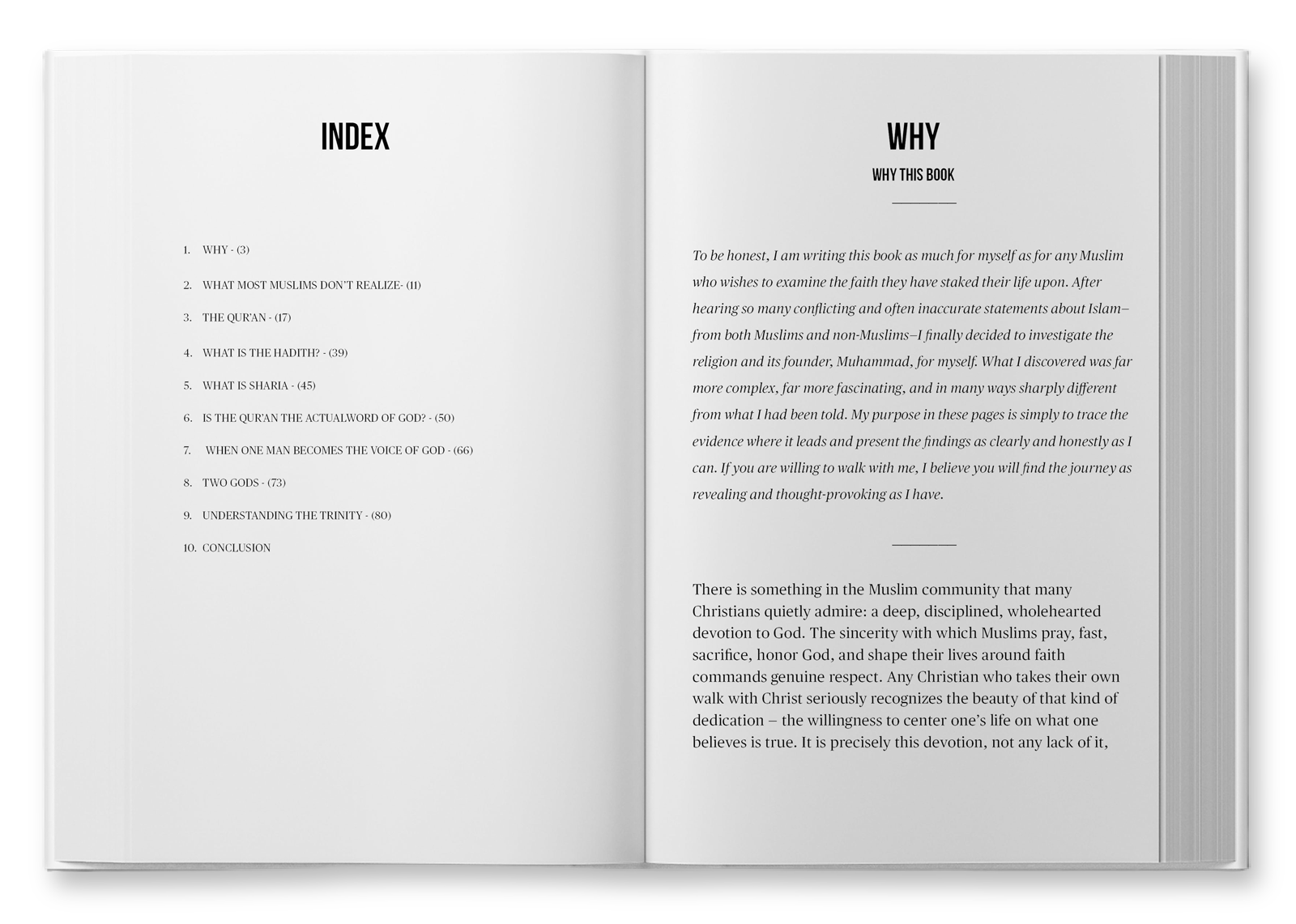
Index
2. What Most Muslims Don’t Realize- (11)
3. The QUr’an – (17)
4. What Is the Hadith? – (39)
5. What Is Sharia – (45)
6. Is The Qur’an The Actual Word Of God? – (50)
7. When One Man Becomes the Voice of God – (66)
8. Two Gods – (73)
9. Understanding the Trinity – (80)
10. Conclusion
98 Pages In Length
Purchase a Copy Today
98 Pages In Length – Approximately 2 Hrs 48 Minute Read Plus References
Paperback
Digital
5 Book Collection
Bulk Discount For Stores, Government, & Military
Let us know your intent and we will provide all information needed.
Sample - Chapter 5
What Is Sharia
Index
2. What Most Muslims Don’t Realize- (11)
3. The QUr’an – (17)
4. What Is the Hadith? – (39)
5. What Is Sharia – (45)
6. Is The Qur’an The Actual Word Of God? – (50)
7. When One Man Becomes the Voice of God – (66)
8. Two Gods – (73)
9. Understanding the Trinity – (80)
10. Conclusion
98 Pages In Length
__________
Most Muslims assume that Sharia—the comprehensive system of Islamic law governing prayer, marriage, criminal punishments, gender roles, inheritance, dress, courts, and political authority—comes directly from the Qur’an. Yet historically, Sharia does not come primarily from the Qur’an. Instead, Islamic law is constructed from four traditional sources, and they are far from equal. The Qur’an contributes only a small portion of the legal material, while the Hadith supply the overwhelming majority of the detailed rules that define Islamic life today. Ijma (scholarly consensus) and qiyas (analogical reasoning) add smaller components, but neither rivals the influence of the Hadith literature.
The Qur’an serves as the theological foundation of Islam, but it offers surprisingly little in terms of legal structure. Out of more than six thousand verses, only around five hundred touch on anything legal, and most of these establish general principles rather than detailed prescriptions. The Qur’an prohibits theft, murder, and adultery, gives broad guidance on fasting and divorce, mentions polygamy under strict conditions, and provides simple inheritance ratios. It emphasizes justice, honesty, compassion, and moral accountability, but it does not supply the vast legal system later known as Sharia. There is no Qur’anic instruction outlining the daily prayer movements, the number of rak‘ahs, or the words to recite. It contains no requirements for hijab or niqab as practiced today, no penalties for apostasy or blasphemy, no stoning punishments, no political structure, no age of marriage, no Sharia court procedures, no detailed divorce or custody arrangements, and no fully developed doctrine of jihad. What many Muslims assume comes from the Qur’an simply is not there. The Qur’an provides the foundation of faith, but not the legal system.
The Hadith, by contrast, form the backbone of Sharia—roughly 75 to 90 percent of the entire structure. These collections, written 150 to 250 years after Muhammad’s death, supply the details that shape virtually every aspect of Islamic practice. They determine how Muslims pray, how zakat is calculated, how the pilgrimage is performed, and how marriages and divorces proceed. They define gender roles, clothing expectations, food regulations, and family structure. They introduce the permissibility of child marriage and outline rules regarding women’s testimony and inheritance. They authorize criminal punishments such as flogging, stoning, amputation, and beheading, and they establish penalties for apostasy (“kill the one who leaves Islam”) and blasphemy. They develop the concept of jihad far beyond the Qur’an’s situational wartime verses, turning it into a comprehensive doctrine of warfare and conquest. Hadith determine leadership qualifications, courtroom procedures, everyday etiquette, and countless social norms. Without the Hadith, nearly all recognizable features of Islamic law and ritual life simply disappear. And yet these texts—forming the bulk of Sharia—were produced generations after Muhammad, not during his lifetime.
A smaller yet still significant part of Sharia comes from ijma, or scholarly consensus, usually defined as the agreement of medieval jurists between the ninth and twelfth centuries. This consensus does not reflect the opinions of ordinary Muslims, nor does it include modern reinterpretations. Instead, ijma frequently reinforced the strictest hadith-based rulings and locked them into permanent law. Consensus supported the death penalty for apostasy, stoning for adultery, Muhammad’s sinlessness, the binding authority of hadith-classification methods, and other doctrines that shaped classical Sharia. Though comprising only a few percent of the legal system, ijma played a crucial role in solidifying the harshest interpretations and making them enduring.
The smallest portion of Sharia, perhaps one or two percent, comes from qiyas, or analogical reasoning. Qiyas functions somewhat like case law, allowing jurists to extend existing rules to new situations. Because wine is forbidden in the Qur’an, qiyas forbids all intoxicants; because theft is prohibited, qiyas extends that to fraud and embezzlement; because certain punishments appear in the Hadith, qiyas expands them to similar offenses. Qiyas does not create new doctrine; it simply stretches existing Qur’anic and hadith-based rules into additional scenarios.
When scholars summarize the sources of Sharia, the pattern is consistent across schools of Islamic law: the Qur’an provides the broad principles (8–12 percent), the Hadith supply the detailed legal framework (75–90 percent), ijma reinforces medieval interpretations (3–5 percent), and qiyas extends those interpretations into new circumstances (1–2 percent). While percentages may vary slightly, the reality does not: the Hadith, not the Qur’an, form the true infrastructure of Islamic law. The Qur’an lays the foundation, but the Hadith build the structure.
This realization often brings a profound shift in perspective. Many Muslims believe Sharia derives directly from the Qur’an. But historically, nearly all of Islamic law arises from human-written hadith collections compiled long after Muhammad’s death. Without those later texts, Sharia would barely exist. Islam as practiced today is not simply the Qur’an expressed in daily life; it is a vast legal and cultural system shaped primarily by the words of men who lived generations after Muhammad, interpreting and codifying thousands of oral reports into binding religious law. Once this becomes clear, the importance of evaluating the Hadith is unmistakable.
NOTE: Footnotes included in book. See book for references.

Matter Of Fact Books
Publishing What Matters Most
What's Behind Matter Of Fact Books
Matter of Fact Books is made up of people much like you—ordinary individuals who work hard to put food on the table and who spent years fumbling through Scripture before its truth finally took root. As for why this book exists, it’s because, over time, we have grown weary of watching good, well-meaning people who call themselves Christians defend beliefs that stand in opposition to God’s Word. Our hope is simple: by presenting facts rather than opinions, readers can see both sides more clearly, choose their position thoughtfully, and help diminish some of the hypocrisy we see in the world today, no matter which side you choose.
Single Book Editions – Coming in 2026
Click image to find out more.