The Answer To The Most Important Question You May Have Stopped Asking.
As a matter of fact...
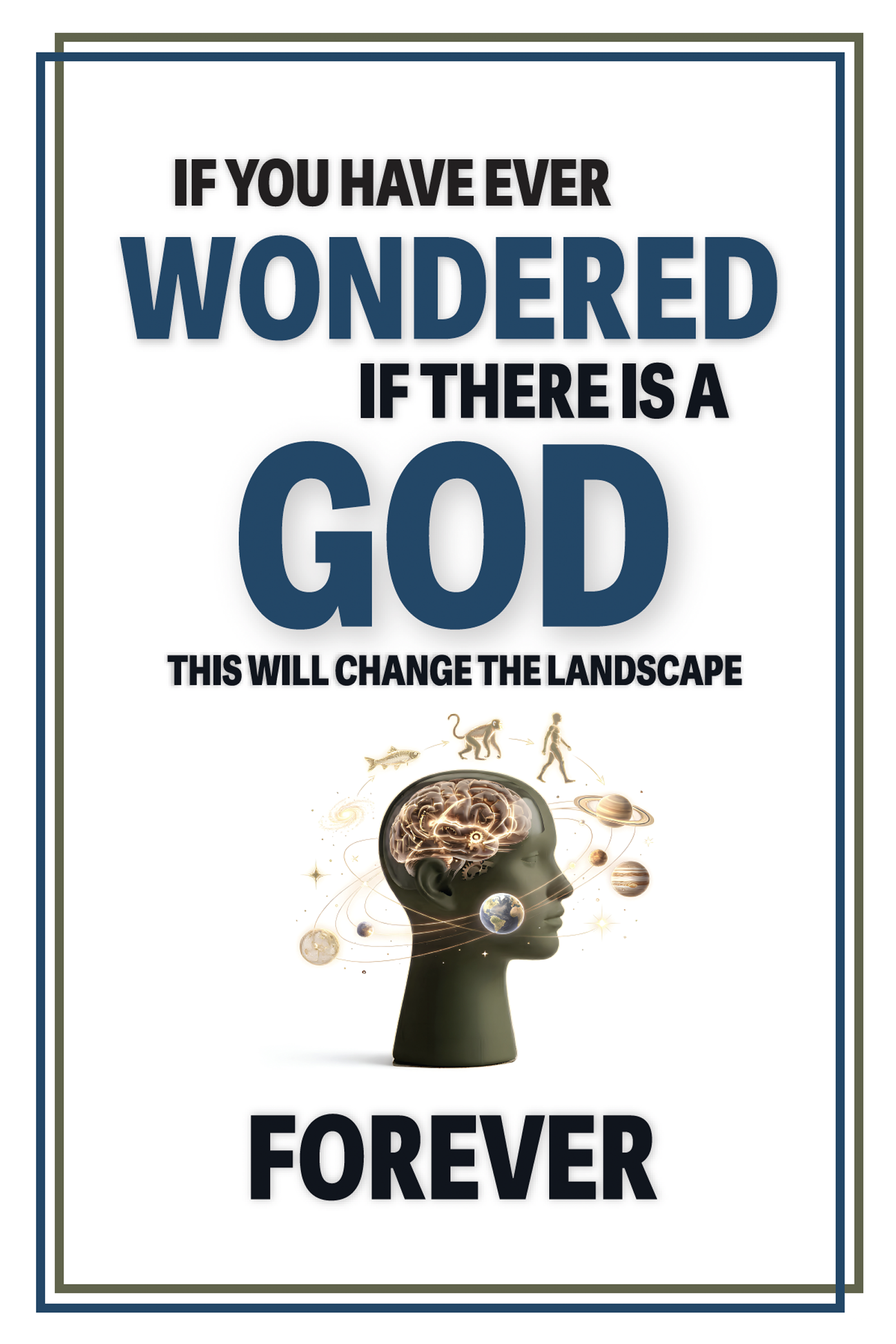
What If The Question of God Was Never Disproved—Only Avoided?
This book is written for those who take truth seriously, including skeptics, atheists, agnostics, and believers who are no longer satisfied with inherited answers. It does not begin by quoting Scripture or demanding faith. It begins with the unavoidable features of human experience: our instinctive sense of right and wrong, the origin and order of the universe, the existence of reason and consciousness, the hunger for meaning, and the stubborn historical question of Jesus of Nazareth.
Rather than caricaturing unbelief, the strongest arguments against God are presented fairly and examined honestly. Each is then placed beside the realities it must explain. The result is not emotional persuasion, but growing intellectual pressure—an accumulation of evidence that forces a reevaluation of assumptions many have never questioned.
This is not a book that promises comfort. It promises clarity. It does not ask whether belief feels helpful, traditional, or inspiring. It asks whether unbelief can truly account for the world as it is—without borrowing concepts it cannot justify.
You may arrive convinced that God does not exist. You may finish persuaded that He does. Or you may find yourself standing in a place you did not expect—no longer certain that disbelief is the most rational position. But if you read honestly, one thing is almost certain, the landscape will not look the same when you are done.
Purchase a Copy Today
533 Pages In Length
Paperback
Digital
Bulk Discount For Stores, Government, & Military
Let us know your intent and we will provide all information needed.
Introduction
the Atheist
Index
Part 1:
If You Do Not Believe In God, Discover The Arguments That Have Changed Everything
- Why – (8)
- The Atheist – (11)
- Morality: Is Right and Wrong Real—or Invented? – (44)
- Origins: Did the Universe Require a Cause? – (55)
- The Laws of Nature: Accident or Calibration? – (69)
- Reason and the Mind: Can Materialism Explain Thought? – (91)
- Jesus of Nazareth: History, Legend, or Resurrection? – (112)
- Meaning and Longing: Why Do Humans Seek More Than Survival? – (144)
- Atheism Examined: Does It Fully Explain the World We Experience? – (171)
Part 2:
Defining God
- If God Exists – (183)
- Why Humans Expect Prophets – (186)
- The Prophet-Centered Structure – (189)
- The Founding Revelation – (194)
- Prophetic Authority – (199)
- The Primary Scripture – (204)
- The Secondary Tradition – (211)
- The Legal | Normative System – (218)
- Institutional Authority – (224)
- Great Religions But More Human Patterns – (237)
- Why Christianity Is Different – (249)
- Something To Consider – (259)
- Understanding The Trinity – (278)
- Conclusion – When the Evidence Points in One Direction – (283)
References – (288)
__________
Atheism is often treated as though it were a single, unified position—a final conclusion reached once religion has been outgrown. In reality, it is neither simple nor singular. Atheism is not a fixed doctrine but a shifting collection of philosophical positions, scientific interpretations, cultural reactions, and personal convictions that have changed dramatically across history. What it meant to deny God in the ancient world is not what it meant during the Enlightenment, the rise of modern science, the turmoil of the twentieth century, or the cultural debates of today. To understand atheism honestly, it must be examined not as a single idea, but as a developing worldview shaped by changing assumptions about reason, nature, morality, and human identity.
Many think of atheism today almost exclusively in scientific terms: as the belief that modern science has rendered God unnecessary. But this understanding is historically recent. For most of human history, the primary debates about God were philosophical and metaphysical, not scientific. The question was not whether science would one day disprove God, but what kind of reality could possibly exist without God at all. The scientific framing of atheism emerged much later, and with it came both new confidence and new problems.
Atheism is also often discussed as though it were simply the absence of belief. But in practice, it functions as a full worldview, carrying with it assumptions about the nature of reality, the origin of the universe, the source of morality, the reliability of reason, the meaning of human life, and the destiny of the self. It makes claims—not only about what does not exist, but about what does exist and why it exists at all. These claims deserve the same careful examination given to any other comprehensive explanation of the world.
This chapter does not approach atheism as an enemy to be ridiculed, nor as a superstition to be dismissed. It approaches atheism as a serious intellectual position that has been held by brilliant minds, fueled by real questions, and shaped by historical forces far larger than any single individual. To understand the arguments that follow in this book, it is essential first to understand where atheism came from, how it developed, what it claims today, and why its relationship to science has both strengthened and complicated it.
Only after seeing atheism in its full historical and intellectual context can its modern arguments be evaluated fairly. What follows is not a critique yet—but a framework: a look at the story of atheism itself, from its earliest philosophical stirrings to its present scientific form, and how the argument has changed as human knowledge has grown.
Continued in “Part 1: If You Do Not Believe In God, Discover The Arguments That Have Changed Everything”

Matter Of Fact Books
Publishing What Matters Most
What's Behind Matter Of Fact Books
Matter of Fact Books is made up of people much like you—ordinary individuals who work hard to put food on the table and who spent years fumbling through Scripture before its truth finally took root. As for why this book exists, it’s because, over time, we have grown weary of watching good, well-meaning people who call themselves Christians defend beliefs that stand in opposition to God’s Word. Our hope is simple: by presenting facts rather than opinions, readers can see both sides more clearly, choose their position thoughtfully, and help diminish some of the hypocrisy we see in the world today, no matter which side you choose.
Single Book Editions – Coming in 2026
Click image to find out more.