
What the Bible Actually Says About Service, Authority, and the Burden You Carry
As a matter of fact...
This is not a book that glorifies war. The Bible does not do that. Nor is it a book that excuses wrongdoing behind the shield of orders. Scripture does not allow that either. What it does offer is clarity: clarity about authority, about obedience, about restraint, about guilt, and about the moral weight carried by those who stand between order and chaos.
If you are a soldier or sailor who has felt this tension—who has wondered whether your service disqualifies you from faithful Christianity—this book is written for you. Not to make you feel better, but to help you see more clearly. Not to give you slogans, but to walk you through what the Bible actually says when it is allowed to speak in full.
Why This Book Was Written
For generations, soldiers, sailors, and law enforcement officers have been told—sometimes subtly, sometimes explicitly—that their service stands in tension with their faith. A handful of verses are quoted, context is ignored, guilt is assumed, and many who have carried real responsibility in real wars are left wondering whether obedience to duty has placed them outside the reach of God.
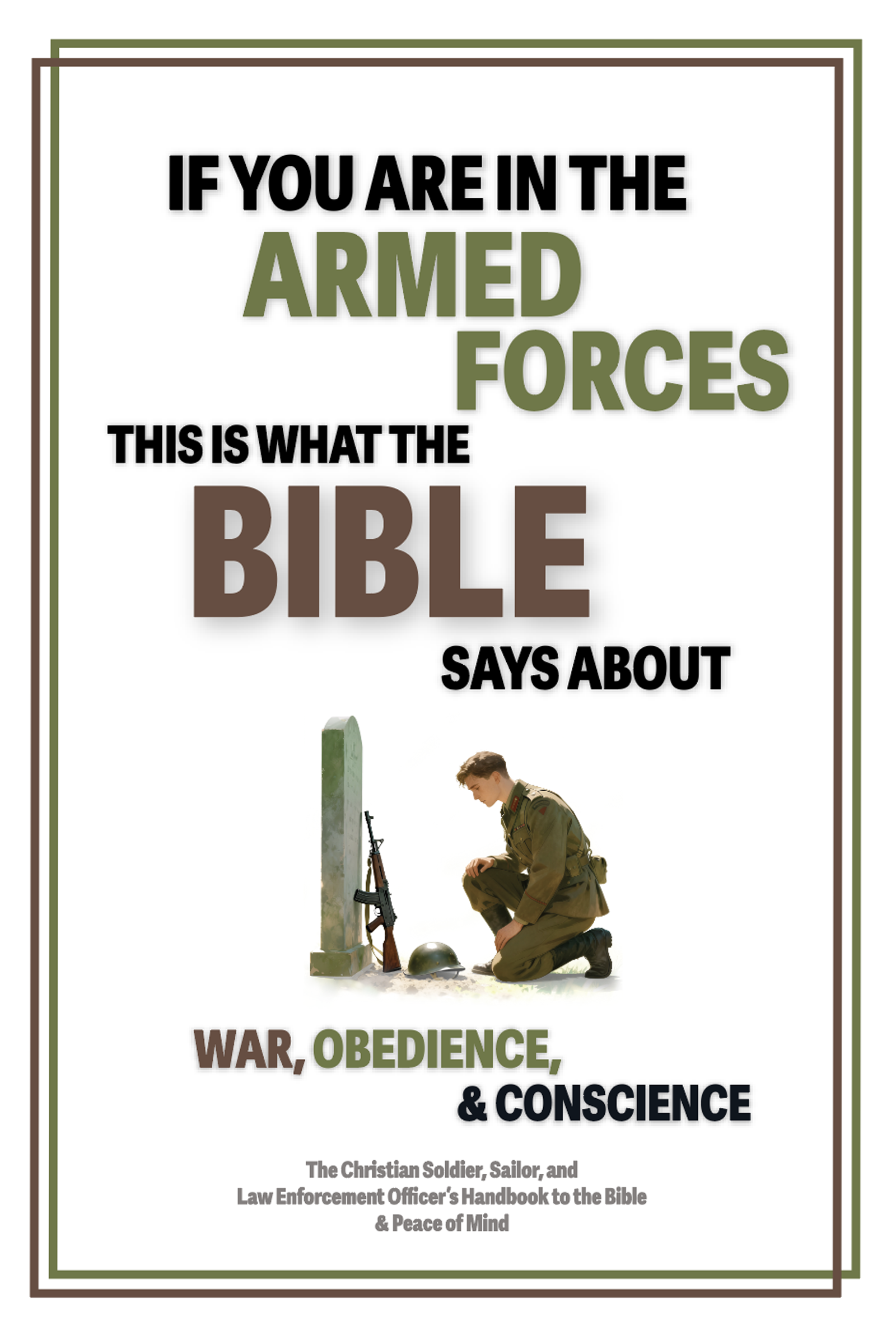
“If You Are in the Armed Forces: What the Bible Says About War, Obedience, and Conscience” challenges that assumption. Written for soldiers, veterans, and anyone willing to read Scripture carefully, this book does not offer slogans or easy answers. Instead, it walks through the Bible as a whole—examining authority, obedience, violence, guilt, and sacrifice as Scripture itself presents them.
From kings and prophets under military threat, to Christ’s encounter with Roman centurions, to the cross where strength and sacrifice meet, the Bible speaks more clearly—and honestly—than many have been taught. Along the way, this book confronts common misunderstandings: that obedience is mechanical rather than moral, that sorrow always equals sin, that quoting verses is the same as knowing Scripture, and that faith requires forgetting what service has cost.
This is not a defense of war, nor an attempt to excuse wrongdoing. It is a serious, Scripture-grounded exploration of what God actually demands of those who bear responsibility—and what He does not. It addresses guilt without minimizing it, acknowledges burden without condemning it, and insists that faith be rooted in truth rather than fear or sentiment.
For those who have served, this book offers something rare: not absolution without honesty, and not judgment without understanding, but a clear-eyed path forward grounded in the full counsel of Scripture.
You were never alone in what you carried, and the Bible is not silent about it.
Index
2. The Lie- (12)
3. The Confusion – (18)
4. Authority – (23)
5. Obedience, Orders, and Moral Responsibility – (29)
6. When Knowing a Verse Is Not Knowing God – (36)
7. “Thou Shalt Not Kill” – (41)
8. The Soldier’s Burden- (47)
9. Guilt – (52)
10. Blood on a Man’s Hands – (58)
11. Christ and the Centurion – (63)
12. Strength, Sacrifice, and the Cross – (69)
13. When the War Doesn’t Leave You – (74)
14. Faith’s Demand – (79)
15. Conclusion – (84)
Ref. Isaiah 7 — Historical Confirmation of the Ahaz Narrative – (88)
96 Pages In Length
Purchase a Copy Today
96 Pages In Length – Approximately 2 Hrs 39 Minute Read Plus Notes

Bulk Discount For Stores, Government, & Military
Let us know your intent and we will provide all information needed.
Sample - Chapter 2
The Lie
Index
2. The Lie- (12)
3. The Confusion – (18)
4. Authority – (23)
5. Obedience, Orders, and Moral Responsibility – (29)
6. When Knowing a Verse Is Not Knowing God – (36)
7. “Thou Shalt Not Kill” – (41)
8. The Soldier’s Burden- (47)
9. Guilt – (52)
10. Blood on a Man’s Hands – (58)
11. Christ and the Centurion – (63)
12. Strength, Sacrifice, and the Cross – (69)
13. When the War Doesn’t Leave You – (74)
14. Faith’s Demand – (79)
15. Conclusion – (84)
Ref. Isaiah 7 — Historical Confirmation of the Ahaz Narrative – (88)
96 Pages In Length
The Lie That Soldiers and Christians Are Opposites
__________
One of the most common ideas soldiers absorb—often without ever being told directly—is that Christianity and military service stand on opposite moral ground. Christianity, they are told, is about love, gentleness, forgiveness, and peace. Soldiering, by contrast, is about force, obedience, violence, and the willingness to harm others. The conclusion feels obvious: you can hold one seriously, but not both at the same time.
This belief does not usually come from reading the Bible. It comes from hearing fragments of it.
Many soldiers first encounter this tension through verses they know well, even if they have never read the surrounding chapters. “Love your neighbor as yourself.” “Turn the other cheek.” “Bless those who persecute you.” Read in isolation, these commands sound absolute and uncomplicated. They appear to leave no room for force, authority, or coercion of any kind. When placed next to the realities of military service, they seem to condemn it outright.
The problem is not that these commands are wrong. The problem is that they are not complete on their own.
“Love your neighbor” comes from a much larger moral framework that Scripture develops over time. In both the Old and New Testaments, love is not defined as the absence of strength or the refusal to confront evil. Love is defined as faithfulness to God and responsibility toward others—even when that responsibility is heavy.
When Jesus summarizes the Law by commanding love for God and neighbor, He is not discarding everything that came before. He is naming the purpose behind it. The same Law that commands love also establishes courts, penalties, borders, leadership, and enforcement. The command to love your neighbor never meant abandoning justice or leaving the innocent unprotected. It meant refusing hatred, vengeance, and cruelty while still taking responsibility for order.
This becomes especially clear when the New Testament is read as a continuous argument rather than a collection of sayings.
Romans 12 is often quoted to support the idea that Christians must never support force under any circumstances. And if Romans 12 stood alone, that conclusion might seem reasonable. Paul urges believers not to repay evil for evil, to live peaceably when possible, and to leave vengeance to God. These instructions are directed at individual conduct—how a Christian is to respond personally when wronged.
Romans 12:17–19 (ESV) – “Repay no one evil for evil, but give thought to do what is honorable in the sight of all. If possible, so far as it depends on you, live peaceably with all. Beloved, never avenge yourselves, but leave it to the wrath of God…”
Read on its own, this passage is often taken to mean that force itself is forbidden. But Paul does not stop writing at the end of chapter 12. What follows immediately in chapter 13 is not a contradiction—it is an explanation of how God restrains evil when individuals are forbidden from doing so themselves.
Romans 13:1, 4 (ESV) – “Let every person be subject to the governing authorities. For there is no authority except from God… for he is God’s servant for your good. But if you do wrong, be afraid, for he does not bear the sword in vain.”
The same God who forbids personal vengeance authorizes civil authority to bear the sword. The transition from Romans 12 to Romans 13 only makes sense if Paul is distinguishing between personal ethics and public responsibility. Individuals are commanded not to avenge themselves. Governments are commanded to restrain evil on behalf of others.
When these chapters are separated, Christians become confused. When they are read together, the moral structure becomes clear.
This distinction runs throughout Scripture. God repeatedly condemns violence rooted in pride, rage, and self-interest. At the same time, He establishes leaders, judges, kings, and governors to uphold order in a fallen world. The absence of authority is never portrayed as virtuous. In fact, Scripture consistently shows that chaos harms the vulnerable first.
The book of Judges offers one of the clearest warnings. Again and again, the text describes a society without centralized authority, concluding with the same refrain: “Everyone did what was right in his own eyes.” The result is not peace. It is exploitation, brutality, and civil collapse. The narrative does not suggest that violence disappears when authority disappears—it multiplies.
This is why the Bible never treats strength itself as evil. Strength without restraint is condemned. Strength without accountability is judged. But strength ordered toward justice and protection is treated as a burden, not a sin.
David’s life demonstrates this tension clearly. He is a warrior and a king, yet also a man deeply aware of moral responsibility. Scripture does not hide the bloodshed associated with his reign, nor does it ignore his failures. When David abuses his authority to orchestrate the death of Uriah, he is confronted, condemned, and disciplined. But the narrative is careful to distinguish between lawful authority exercised imperfectly and murder committed to conceal personal sin. David is not rebuked for being a soldier; he is rebuked for becoming a murderer.
The New Testament continues this pattern rather than overturning it. When soldiers appear in the Gospels, they are not treated as moral outcasts. In Luke 3, John the Baptist is asked directly what repentance looks like for soldiers. His answer is striking precisely because of what it does not include.
Luke 3:14 (ESV) – “Soldiers also asked him, ‘And we, what shall we do?’ And he said to them, ‘Do not extort money from anyone by threats or by false accusation, and be content with your wages.’”
John does not command them to abandon their profession. He commands restraint, justice, and integrity within it. The assumption is that service itself is not incompatible with faith—abuse of power is.
Jesus’ encounter with the Roman centurion reinforces the same truth. The centurion understands authority because he lives under it and exercises it. Jesus does not recoil from that explanation. He praises it.
Matthew 8:8–10 (ESV) “But the centurion replied, ‘Lord, I am not worthy to have you come under my roof, but only say the word, and my servant will be healed. For I too am a man under authority, with soldiers under me…’ When Jesus heard this, he marveled…”
Authority, command, and obedience are not portrayed as spiritual defects. They are used to illustrate faith itself.
The lie that soldiers and Christians are opposites survives only when Scripture is reduced to sound bites. “Love your neighbor” is true—but love is not the same as permissiveness. “Turn the other cheek” is real—but it addresses personal retaliation, not the collapse of justice. Romans 12 is essential—but it cannot be severed from Romans 13 without distorting both.
When the Bible is read as a whole, the supposed contradiction fades. What remains is something far more demanding: a call to wield authority humbly, to exercise force reluctantly, to submit to accountability, and to recognize the moral weight of bearing responsibility in a broken world.
The tension soldiers feel is real—but it does not come from God’s Word. It comes from hearing parts of it without the rest. And once that lie is exposed, the conversation can finally move forward.

Matter Of Fact Books
Publishing What Matters Most
What's Behind Matter Of Fact Books
Matter of Fact Books is not the work of one person. It is inspired by God and shaped through Scripture, conviction, and years of deep conversation—often around a table with an amazing group of friends, a glass of scotch, and a refusal to accept shallow answers. We’re not here to shout opinions. We’re here to present facts, side-by-side truth, and clear reasoning—so readers can examine what they believe, why they believe it, and whether it aligns with what they claim to profess.
Matter Of Fact Books
Click image to find out more.



Matter Of Fact Books
Our books are priced to sell and change lives.